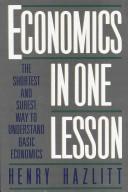
Economics in One Lesson
Judge a policy by its long-run effects on all groups, applied to two dozen cases.
Hazlitt's 1946 distillation of Bastiat's 'broken window' insight: good economic reasoning requires seeing both what is visible and what is made invisible by a policy. A short book that teaches a single analytical habit, and that habit is genuinely useful regardless of your politics.
Summary
Hazlitt states a single lesson and then applies it to twenty-odd policy questions. The lesson is that economics consists in looking not only at the immediate effects of a policy but at the longer effects, and not only at the consequences for one group but for all groups. He takes it from Bastiat's essay on what is seen and what is not seen, and the broken window fallacy is the opening illustration: repairing a broken window employs a glazier, which is visible, and prevents the shopkeeper from spending the same money elsewhere, which is not.
He applies the lesson to public works, taxation, credit programmes, tariffs, export subsidies, price controls, rent control, minimum wages, unions, profits, saving, and the effect of technology on employment. In each case he identifies a group that visibly benefits and a diffuse cost borne by people who cannot identify it.
The book is short, clear and written for a general reader without any mathematics. It was published in 1946 and revised in 1979.
It is a work of advocacy rather than of analysis. Hazlitt writes from the Austrian tradition and treats contested empirical questions as settled by logic. The minimum wage chapter, in particular, states as certain a result that subsequent empirical research including Card and Krueger has made genuinely contested. He does not engage seriously with market failure, externalities, monopsony, information asymmetry or public goods. Readers should treat it as a well-stated version of one position rather than as an introduction to economics, and should read something covering the opposing arguments alongside it.
Key takeaways 8
- Any policy must be judged by its longer-term effects on all groups rather than by its immediate effect on the intended beneficiary.
- Destruction does not create wealth, since the resources used for repair would otherwise have produced something additional.
- Government spending is funded by taxation or borrowing, so the jobs it creates are offset by jobs not created elsewhere, which are not observed.
- Tariffs protect a visible domestic industry while imposing diffuse costs on consumers and on export industries that no one attributes to the tariff.
- Price controls produce shortages because they suppress the signal that would have called forth additional supply.
- Rent control reduces the supply and quality of housing over time while benefiting current tenants immediately.
- Technology that eliminates jobs in one industry releases labour and capital that produce more elsewhere, though the displacement is real for the people affected.
- Hazlitt treats several genuinely contested empirical questions, including minimum wage effects, as settled by logic alone.
Who should read it
Readers who want the clearest short statement of the case against intervention, read alongside a source covering the arguments Hazlitt does not engage.
Who recommended it 5 · 1 direct
“I've given dozens of copies of this classic to students... The book should be required reading on every campus.”
Similar books 6
Chosen by shared topics, the entries that hold them, and the people who recommended both.
How prices, incentives and trade-offs work, from housing and labour to trade.
Recommended by: Marc Andreessen
How the division of labour and free markets make a nation rich.
“In The Wealth of Nations (published in 1776) Smith noted that land prices had risen in recent decades, as interest rates declined.” — Howard Marks
Source: Easy Money
Recommended by: Howard Marks, John C. Bogle and 11 others
Price theory in daily life: coffee near stations, supermarket tiers and used cars.
Recommended by: Mohnish Pabrai, Naval Ravikant

A novel in which two teachers argue for and against markets.
“there is a book called The Invisible Heart which explains basic economics to most people” — Joel Greenblatt
Source: Masters in Business transcript: Joel Greenblatt (2018)
Recommended by: Joel Greenblatt, Mohnish Pabrai
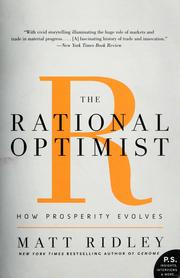
Prosperity grows as trade and specialisation let ideas meet and combine.
“…books I've recommended, highlighted to death, or forced on friends.” — Andrew Wilkinson
Source: Andrew Wilkinson's Bookshelf, neverenough.com
Recommended by: Andrew Wilkinson, Bill Gates, Frank Martin and 12 others
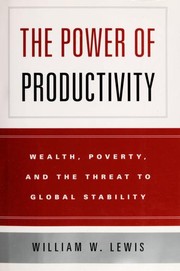
Why productivity differs so much between countries, sector by sector.
“on how technology-driven productivity growth improves human welfare and creates more jobs and higher wages” — Marc Andreessen
Source: @pmarca, companion thread to 'It's Time to Build'
Recommended by: Marc Andreessen, Patrick Collison
Where it sits in the reference 3
Topics 1
As an Amazon Associate I earn from qualifying purchases.