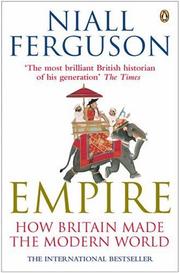
Empire: The Rise and Demise of the British World Order and the Lessons for Global Power
How the British Empire shaped the modern world, from globalisation to democracy.
Summary
Ferguson argues that the British Empire should be seen not as vanished Victoriana but as the cradle of the modern world. It was the largest empire in history: on the eve of the Second World War more than a fifth of the world's land and nearly a quarter of its population lived under some form of British rule. Yet for the present generation it stands for a remote Victorian past, and Ferguson offers a reappraisal.
In his account nearly every key feature of the twenty-first-century world traces back to the expansion of Britain's economy, population and culture from the seventeenth century to the mid-twentieth: economic globalisation, the communications revolution, the racial make-up of North America, the idea of humanitarianism and the nature of democracy. He argues that the empire's story is not a subject for nostalgia but a source of lessons, above all for the United States as it moves toward a new kind of imperial power built, as Britain's was, on economic and military supremacy.
Key takeaways 4
- The British Empire was the largest in history, covering a fifth of the world's land by 1939.
- Globalisation, modern communications and the spread of democracy trace back to British expansion.
- Ferguson treats the empire as the starting point of the modern world rather than a relic.
- The British experience holds lessons for the United States as a power built on economic and military supremacy.
Who should read it
Readers interested in how an empire built the first global economy and what its rise and decline mean for American power.
About Niall Ferguson
Historian and senior fellow at the Hoover Institution, Stanford; previously taught at Oxford, Harvard and NYU Stern.
The Ascent of Money traces credit, bond markets, joint-stock equity, insurance and property finance from their origins, giving investors the institutional history behind instruments they price every day. The House of Rothschild and High Financier examine how two banking houses actually made money and managed sovereign and political risk over long periods.
Who recommended it 1 · 1 direct
Similar books 6
Chosen by shared topics, the entries that hold them, and the people who recommended both.
Six advantages, from competition to the work ethic, that let the West pull ahead.
Recommended by: Mohnish Pabrai, Li Lu
The history of finance by instrument: credit, bonds, stocks, insurance and property.
Recommended by: Mohnish Pabrai, Marc Andreessen, Max Levchin and 3 others
Why Germany could not pay the 1919 reparations, and what they would do to Europe.
“Consider the following quote from John Maynard Keynes in The Economic Consequences of the Peace: The inhabitant of London could order by telephone, sipping his morning tea in bed, the various products of the whole earth, in such quantity as he might see fit, and reasonably expect their early delivery upon his doorstep; he could at the same moment and by the same means adventure his wealth in the natural resources and new …” — William J. Bernstein
Source: Efficient Frontier, issue 901 (2001)
Recommended by: William J. Bernstein
Britain's entry turned a continental war into a world war that was not inevitable.
Recommended by: Mohnish Pabrai
Why the 20th century's great progress came with unprecedented violence.
Recommended by: Mohnish Pabrai
A narrative biography of Winston Churchill's nearly sixty years in British politics.
Recommended by: Mohnish Pabrai