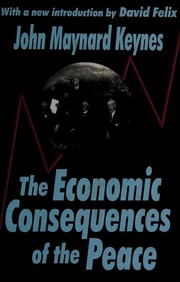
The Economic Consequences of the Peace
Why Germany could not pay the 1919 reparations, and what they would do to Europe.
Written before the fact by a Treasury insider; the reparations arithmetic that set up the collapse.
Summary
John Maynard Keynes attended the Paris Peace Conference as a Treasury representative, resigned in protest, and wrote this in the following months. It was published in December 1919 and made him internationally famous.
His argument has two parts. The analytical part concerns capacity: he calculates what Germany could actually pay in reparations given its productive capacity, its loss of territory, resources and merchant fleet, and the trade surpluses it would need to generate, and concludes that the sums demanded were far beyond any plausible transfer. He also identifies the transfer problem, which is that paying reparations requires not only raising the money domestically but converting it into foreign exchange through exports the recipients would have to accept.
The political part concerns the European economy as an interdependent system. Keynes argues that the prewar economy depended on German industrial production, on the movement of coal and food across borders, and on a financial system the war had destroyed, and that impoverishing Germany would damage the whole. The book also contains the character sketches of Wilson, Clemenceau and Lloyd George that made it notorious. Its influence was enormous and contested: Etienne Mantoux argued in 1946 that Keynes underestimated German capacity and that his book weakened the will to enforce the treaty, and the debate continues. The transfer problem analysis is a permanent contribution to economics.
Key takeaways 7
- Reparations require not only raising money domestically but converting it into foreign exchange, which recipients must accept as imports.
- Keynes calculated Germany's plausible payment capacity as far below the sums the treaty demanded.
- The prewar European economy was interdependent, so impoverishing one large producer damages the whole system.
- Territorial and resource losses reduced German capacity to pay at the same time that the demands on it increased.
- Keynes argues that the treaty's authors pursued political objectives without any economic analysis of feasibility.
- Mantoux's later criticism holds that Keynes underestimated German capacity and weakened enforcement, and the debate is unresolved.
- A demand for payment that cannot be met produces default and resentment rather than revenue.
Who should read it
Investors and analysts who want the origin of the transfer problem and a demonstration of what happens when debt demands exceed capacity to pay.
Who recommended it 1 · 1 direct
“Consider the following quote from John Maynard Keynes in The Economic Consequences of the Peace: The inhabitant of London could order by telephone, sipping his morning tea in bed, the various products of the whole earth, in such quantity as he might see fit, and reasonably expect their early delivery upon his doorstep; he could at the same moment and by the same means adventure his wealth in the natural resources and new …”
Similar books 6
Chosen by shared topics, the entries that hold them, and the people who recommended both.
A history of economic theory and the economists who built it.
Recommended by: Eric Weinstein
An early argument on building, the construction trade, taxes and population.
Recommended by: Marc Andreessen

Why population growth always presses against the food supply.
Recommended by: Mohnish Pabrai
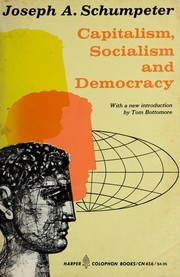
Capitalism runs on creative destruction, and its success may lead it to socialism.
“Joseph A Schumpeter, Capitalism, Socialism and Democracy (New York: Harper & Row, 1942)” — Michael Mauboussin
Source: Why Corporate Longevity Matters: What Index Turnover Tells Us about Corporate Results, page 14
Recommended by: Jim Collins, Michael Mauboussin, Li Lu

Why capitalism runs on the exploitation of labour, the source of surplus value.
“Karl Marx, Das Kapital, A Critique of Political Economy (Washington, DC: Regnery Publishing, 1996): 347” — Michael Mauboussin
Source: A Piece of the Action: Employee Stock Options in the New Economy, page 44
Recommended by: Michael Mauboussin, Elon Musk

How the gold standard spread the Depression, and why leaving it early meant recovery.
“Eichengreen, Barry. Golden Fetters: The Gold Standard and the Great Depression, 1919–1939. New York: Oxford University Press, 1996” — Ray Dalio
Source: The Changing World Order — citations and bibliography, page 29
Recommended by: Ray Dalio