
Das Kapital
Why capitalism runs on the exploitation of labour, the source of surplus value.
Summary
Marx argues that the driving force of capitalism is the exploitation of labour, whose unpaid work is the source of surplus value and profit. Starting from an analysis of the commodity, he presents capitalism as a historically specific system in which social relations are mediated by commodity exchange. Under his labour theory of value, a commodity's value is set by the socially necessary labour time needed to make it; the worker sells labour power, whose capacity to create value exceeds the wage, and the capitalist keeps the difference. This drives accumulation, technological change, a reserve army of the unemployed and a tendency of the rate of profit to fall, leading to crises and class conflict.
The work is in three volumes: Volume I, published in 1867, on production; Volume II on the circulation of capital; and Volume III on the process as a whole, including the division of surplus value into profit, interest and rent. Friedrich Engels completed the last two from Marx's manuscripts in 1885 and 1894. A key theme is commodity fetishism, in which social relations appear as relations between things. It became foundational to the labour movement, socialist and communist parties and several academic fields.
Key takeaways 4
- Marx locates profit in the unpaid portion of workers' labour, which he calls surplus value.
- A commodity's value, in his theory, is set by the labour time socially necessary to produce it.
- Capital accumulation, in Marx's account, drives technological change, unemployment and a falling rate of profit that produce crises.
- Commodity fetishism describes how market prices hide the social relations behind production.
Who should read it
Readers who want the original source of Marxist economics rather than accounts of it, including investors who want to understand its critique of capital.
Who recommended it 2 · 1 direct
“Karl Marx, Das Kapital, A Critique of Political Economy (Washington, DC: Regnery Publishing, 1996): 347”
Similar books 6
Chosen by shared topics, the entries that hold them, and the people who recommended both.
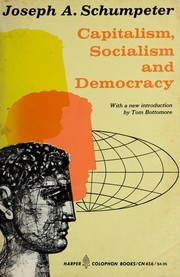
Capitalism runs on creative destruction, and its success may lead it to socialism.
“Joseph A Schumpeter, Capitalism, Socialism and Democracy (New York: Harper & Row, 1942)” — Michael Mauboussin
Source: Why Corporate Longevity Matters: What Index Turnover Tells Us about Corporate Results, page 14
Recommended by: Jim Collins, Michael Mauboussin, Li Lu
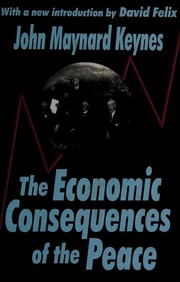
Why Germany could not pay the 1919 reparations, and what they would do to Europe.
“Consider the following quote from John Maynard Keynes in The Economic Consequences of the Peace: The inhabitant of London could order by telephone, sipping his morning tea in bed, the various products of the whole earth, in such quantity as he might see fit, and reasonably expect their early delivery upon his doorstep; he could at the same moment and by the same means adventure his wealth in the natural resources and new …” — William J. Bernstein
Source: Efficient Frontier, issue 901 (2001)
Recommended by: William J. Bernstein
How the division of labour and free markets make a nation rich.
“In The Wealth of Nations (published in 1776) Smith noted that land prices had risen in recent decades, as interest rates declined.” — Howard Marks
Source: Easy Money
Recommended by: Howard Marks, John C. Bogle and 11 others
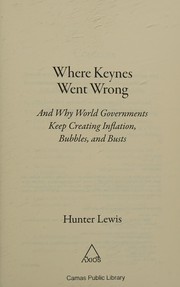
A polemic against Keynesian policy from an Austrian-leaning investor.
“This is another timely classic given the present condition. The outline structure of the book is brilliant.” — Christopher Bloomstran
Source: Semper Augustus 2020 Letter to Clients, 'To Read or Not to Read', p. 57
Recommended by: Christopher Bloomstran

Books One to Three: division of labour, money, prices, wages, profit and capital.
“Adam Smith, An Inquiry into the Nature and Causes of the Wealth of Nations (London: W. Strahan and T. Cadell, 1776)” — Michael Mauboussin
Source: Increasing Returns: Identifying Forms of Increasing Returns and What Drives Them, page 15
Recommended by: Michael Mauboussin, Mohnish Pabrai and 1 other

How economics copied the maths of 19th-century physics, and what that cost it.
“Mirowski, Philip, More Heat than Light: Economics as Social Physics, Physics as Nature’s Economics (Cambridge: Cambridge University Press, 1989)” — Michael Mauboussin
Source: Size Matters: The Kelly Criterion and the Importance of Money Management, page 12
Recommended by: Michael Mauboussin, Eric Weinstein
Where it sits in the reference 1
Topics 3
As an Amazon Associate I earn from qualifying purchases.