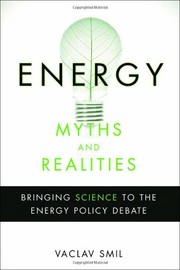
Energy Myths and Realities
Common claims about energy tested against the record of past energy transitions.
Summary
In a 2010 volume from AEI Press, Vaclav Smil takes a list of claims common in political debate about energy and sets each against the record. New sources and technologies will not replace fossil fuels within a few decades, he argues, because full energy transitions take several generations. Carbon sequestration will not prevent a further large rise in emissions, given its cost, technical difficulty and problems of public acceptance. Electric cars are expensive and will spread slowly, and internal combustion engines will dominate for decades. Conventional oil's share will shrink gradually, but liquid hydrocarbons will remain a major source for decades.
On nuclear power he holds that no rational long-range plan should exclude it, but experience calls for caution over risk perceptions, proliferation and permanent waste sites. Corn ethanol can meet only a small share of fuel needs, and scaling it up would degrade the environment. Wind power's near-term contribution is exaggerated by its variability, uneven geography, low power density and missing infrastructure. Any global transition, he concludes, will be long, expensive and dependent on new infrastructure, and policy must start by discarding these myths.
Key takeaways 5
- Full energy transitions take several generations, not a few decades.
- Carbon sequestration, corn ethanol and wind power cannot deliver what their advocates promise in the short term.
- Electric cars will spread slowly while combustion engines dominate for decades.
- Nuclear power belongs in any long-range plan, with caution about waste, proliferation and public fears.
- Sound energy policy starts by rejecting exaggerated claims.
Who should read it
Policy readers and investors who want a sceptical, numbers-first check on popular forecasts about energy.
About Vaclav Smil
Distinguished professor emeritus at the University of Manitoba; writes quantitative histories of energy, food, materials and technical change.
Each book counts the physical inputs an economy consumes - joules, tonnes of steel, ammonia, cement - and establishes the historical rates at which past energy transitions actually moved. Those numbers let an investor size decarbonisation timelines and test claims about how fast an energy system can be rebuilt.
Who recommended it 1 · 1 direct
Similar books 6
Chosen by shared topics, the entries that hold them, and the people who recommended both.
How energy is transformed to power the biosphere and human society.
Recommended by: Bill Gates

A short primer on energy: its forms, units and role in nature and economies.
Recommended by: Nat Eliason, Bill Gates, Mark Zuckerberg
The physical basics of modern life: energy, food, materials and globalisation.
Recommended by: Bill Gates
Whether Britain could live on renewables, worked out in numbers per person.
Recommended by: Bill Gates
How industry could use far less steel, cement, plastic, paper and aluminium.
Recommended by: Bill Gates
Nuclear accidents, what went wrong in each, and what each taught about the atom.