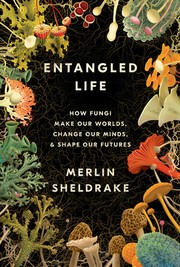
Entangled Life: How Fungi Make Our Worlds, Change Our Minds and Shape Our Futures
How fungi shape life on Earth, from underground networks to the mind.
Summary
Merlin Sheldrake, a British biologist with a Cambridge PhD in tropical ecology for work on underground fungal networks in the forests of Panama, published his first book with Random House on 12 May 2020. It examines fungi from several angles: decomposition, fermentation, the distribution of nutrients, the production of psilocybin, the evolutionary role fungi have played in the life of plants, and the ways humans relate to the fungal kingdom. It introduces readers to the main strands of research in mycology and is also a personal account of Sheldrake's own experiences with fungi, using music and philosophy to make its case.
Jennifer Szalai of The New York Times called it an "ebullient and ambitious exploration", and The Wall Street Journal placed it in the tradition of literary nature writing by Robert Macfarlane and John Fowles. It won the 2021 Royal Society Science Book Prize, the Wainwright Prize for global conservation writing and the Guild of Food Writers First Book Award. Time named it one of the 100 must-read books of 2020, and BBC Radio 4 serialised it as its Book of the Week.
Key takeaways 4
- Fungi shape the living world through decomposition, fermentation and the movement of nutrients.
- Plants evolved in partnership with fungi, and underground fungal networks link them still.
- Sheldrake draws on mycological research and on his own fieldwork and experiences.
- The book won the 2021 Royal Society Science Book Prize.
Who should read it
General readers interested in biology and ecology who want to learn how fungi shape life on Earth.
Who recommended it 1
Similar books 6
Chosen by shared topics, the entries that hold them, and the people who recommended both.
An illustrated account of how living things grow, develop, reproduce and get by.
Recommended by: Stewart Brand
Dinosaurs for adults who loved them as children and want to know more.
Recommended by: Sophie Bakalar
The forest of Barro Colorado Island in photographs and ecology.
Recommended by: Ray Dalio
An undergraduate biology textbook, from cells and genetics to evolution.
Recommended by: Mohnish Pabrai
The last of the Corfu books: a naturalist's childhood among animals on Corfu.
Recommended by: Paul Graham