Everything Is Obvious: Once You Know the Answer
Why common sense misleads people when they try to explain how the world works.
Summary
Duncan Watts, a sociologist and pioneer of network science, argues that common sense, which works well for everyday life, misleads people when they try to explain or predict how social and economic systems behave. He opens with questions such as why the Mona Lisa is the most famous painting in the world, why Facebook succeeded where other social networks failed, whether the surge in Iraq reduced violence, how much chief executives affect their companies' results, and whether higher pay makes people work harder.
The explanations people give for outcomes seem obvious once the outcome is known, but they are less useful than they look. Drawing on research and on historical and contemporary cases, Watts shows how common-sense reasoning and hindsight lead people to believe they understand human behaviour better than they do, and why efforts to predict, manage or manipulate social systems so often fail. Policymakers and managers misjudge how people will respond to incentives; marketers cannot identify influential people in advance; successful products seem destined in hindsight but are hard to pick beforehand. Only by understanding when common sense fails, he argues, can planning in politics, business and marketing improve.
Key takeaways 4
- Explanations that seem obvious after the fact rarely help predict the next outcome.
- Common sense is built for everyday situations, not for complex social systems.
- People's responses to incentives are harder to anticipate than managers assume.
- Influencers and future hits are almost impossible to identify in advance.
Who should read it
Managers, marketers and policymakers who want to understand the limits of prediction in social and economic systems.
Who recommended it 4 · 4 direct
“Tonight’s book was Everything Is Obvious* which was cleverly subtitled *Once You Know The Answer with a special bonus subtitle How Common Sense Fails Us by Duncan Watts. And yes – for those of you keeping track at home, I didn’t read a book last night; I was working on mine instead. I enjoyed this book.”
“Common sense and intuition are often wrong. They are like mythology, good for explaining events with stories, but not for understanding. Some good insights here.”
“Also, see the chapter, “History, The Fickle Teacher,” in Duncan J. Watts, Everything Is Obvious*:*Once You Know the Answer (New York: Crown Business, 2011), 108-134”
Similar books 6
Chosen by shared topics, the entries that hold them, and the people who recommended both.
How timing, culture and accumulated advantage explain exceptional success.
“Deep study of why some people are so much more successful. Often due to circumstances and early opportunities, but really comes down to the fact that it takes about 10,000 hours of hard work to master something.” — Derek Sivers
Source: Derek Sivers book notes (primary, rated list) · Rating: 5/10
Recommended by: Derek Sivers, Howard Marks and 11 others
Why people mistake luck for skill, above all in markets.
“Fooled By Randomness was unquestionably the best non-fiction book I read in 2005.” — Brad Feld
Source: Book Review: Fooled By Randomness — Feld Thoughts
Recommended by: Barton Biggs, Brad Feld, Derek Sivers and 15 others
How ideas and behaviour spread like epidemics, and the three factors that tip them.
“As Yogi Berra said, "It's tough to make predictions, especially about the future." As anyone who has read Malcolm Gladwell's book, THE TIPPING POINT, will understand, pressures for a significant reversal can build with no apparent effect until they reach a certain point.” — Christopher Browne
Source: Tweedy, Browne Fund Inc. N-CSR shareholder report, fiscal year ended March 31, 2006
Recommended by: Christopher Browne, Jim Collins and 6 others
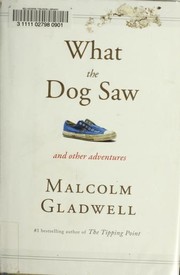
Essays on puzzles such as choking versus panicking and why ketchup has one variety.
“A pretty-good collection of his articles from the past few years. While most are somewhat interesting, it felt a little like surfing the net or TV. Lots of “huh”, but no lasting insights. More entertainment than education.” — Derek Sivers
Source: Derek Sivers book notes (primary, rated list) · Rating: 2/10
Recommended by: Derek Sivers, Mohnish Pabrai
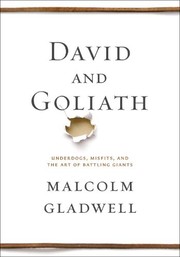
Why people misjudge advantage, and how underdogs win.
“…books I've recommended, highlighted to death, or forced on friends.” — Andrew Wilkinson
Source: Andrew Wilkinson's Bookshelf, neverenough.com
Recommended by: Andrew Wilkinson, John C. Bogle and 2 others
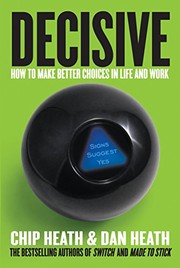
Four traps that ruin decisions, such as narrow framing, and a process to beat each.
“Interesting and insightful dive into the subject of how to make big decisions. Specific useful advice.” — Derek Sivers
Source: Derek Sivers book notes (primary, rated list) · Rating: 8/10
Recommended by: Andrew Wilkinson, Derek Sivers and 6 others