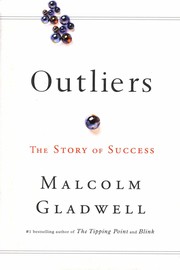
Outliers
How timing, culture and accumulated advantage explain exceptional success.
Summary
Gladwell argues that exceptional success is explained by circumstances, timing, cultural inheritance and accumulated advantage rather than by individual talent and effort. The book is a set of case studies organised into opportunity and legacy.
The opportunity section covers relative age effects in Canadian hockey, where players born in the first months of the year dominate rosters because of the eligibility cutoff and the accumulating advantage of early selection; the ten thousand hour claim about practice, drawn from Anders Ericsson's research and illustrated with the Beatles in Hamburg and Bill Gates' unusual access to a computer terminal as a teenager; the birth-year clustering of technology founders and of nineteenth-century American industrialists; and the finding that very high intelligence beyond a threshold does not predict achievement, illustrated with Chris Langan against Robert Oppenheimer to argue that practical intelligence learned from family background determines who can act on opportunity.
The legacy section argues that cultural inheritance persists across generations, covering honour culture in the American South, the correlation between national power distance and airline accident rates using Korean Air as the case, and the argument that rice agriculture produced work habits that explain mathematics performance in East Asian countries.
The ten thousand hours claim is the most consequential and the most wrong. Ericsson himself objected that the number was an average rather than a threshold, that deliberate practice differs from accumulated hours, and that the amount required varies enormously by domain. The cultural chapters rest on correlational arguments that specialists reject. The relative age effect is well supported. Read the book as a set of provocations rather than as findings.
Key takeaways 8
- Success attributed to individual talent usually depends on circumstances of timing, access and accumulated early advantage.
- Arbitrary cutoff dates produce relative age effects, where children who are marginally older receive better coaching and opportunities that compound into real skill differences.
- Extraordinary performers accumulated unusual amounts of practice through circumstances that gave them access others did not have.
- Intelligence beyond a threshold does not predict achievement, and practical social competence learned from family background determines who converts ability into results.
- Birth year clusters among successful founders and industrialists indicate that being the right age at a technological transition matters more than individual quality.
- Cultural inheritance including attitudes to authority persists across generations and affects performance in domains far removed from its origin.
- Hierarchical communication patterns in cockpits contributed to accident rates, and changing the communication protocol changed the outcomes.
- The ten thousand hours figure is a misreading of the underlying research, which described an average rather than a threshold and emphasised the type of practice rather than the quantity.
Who should read it
Readers who want a provocation against pure meritocratic explanations of success, with the specific claims checked against the research they draw on.
Who recommended it 13 · 5 direct
“Deep study of why some people are so much more successful. Often due to circumstances and early opportunities, but really comes down to the fact that it takes about 10,000 hours of hard work to master something.”
“Outliers is best known for Gladwell’s observation that it’s this magic number of hours of practice that makes the difference for those who are most successful.”
“Gladwell, Malcolm, Outliers: The Story of Success (New York: Little, Brown and Company, 2008)”
Similar books 6
Chosen by shared topics, the entries that hold them, and the people who recommended both.
Why common sense misleads people when they try to explain how the world works.
“Tonight’s book was Everything Is Obvious* which was cleverly subtitled *Once You Know The Answer with a special bonus subtitle How Common Sense Fails Us by Duncan Watts. And yes – for those of you keeping track at home, I didn’t read a book last night; I was working on mine instead. I enjoyed this book.” — Brad Feld
Source: Book: Everything Is Obvious* — Feld Thoughts
Recommended by: Brad Feld, Derek Sivers, Michael Mauboussin and 1 other
A journalist learns memory techniques and wins the US Memory Championship.
“For those fascinated with memory. Riveting page-turner about a journalist (with no particularly good memory) who went to cover a memory championship event. Intrigued and befriending some competitors, he starts practicing, and a year later wins the U.S. memory championship event himself. Inspiring dive into the subject of memorization.” — Derek Sivers
Source: Derek Sivers book notes (primary, rated list) · Rating: 8/10
Recommended by: Bill Gates, Derek Sivers, Mohnish Pabrai and 5 others
How ideas and behaviour spread like epidemics, and the three factors that tip them.
“As Yogi Berra said, "It's tough to make predictions, especially about the future." As anyone who has read Malcolm Gladwell's book, THE TIPPING POINT, will understand, pressures for a significant reversal can build with no apparent effect until they reach a certain point.” — Christopher Browne
Source: Tweedy, Browne Fund Inc. N-CSR shareholder report, fiscal year ended March 31, 2006
Recommended by: Christopher Browne, Jim Collins and 6 others

Whether adults can meet the mental demands of modern life.
Recommended by: Graham Duncan, Ray Dalio
Why finding one's way later in life can be an advantage.
Recommended by: Arianna Huffington
Essays on puzzles such as choking versus panicking and why ketchup has one variety.
“A pretty-good collection of his articles from the past few years. While most are somewhat interesting, it felt a little like surfing the net or TV. Lots of “huh”, but no lasting insights. More entertainment than education.” — Derek Sivers
Source: Derek Sivers book notes (primary, rated list) · Rating: 2/10
Recommended by: Derek Sivers, Mohnish Pabrai