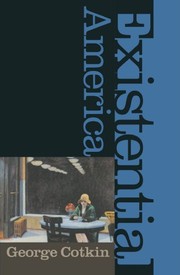
Existential America
How existentialism took root in American thought.
Summary
George Cotkin, a historian, challenges the view of Sartre, Beauvoir and Camus that Americans were too confident and shallow for a philosophy of responsibility, choice and the absurd. Sartre said in 1950 that there was no pessimism in America about human nature, Beauvoir wrote that Americans had no feeling for sin and remorse, and Camus mocked American materialism. Yet existentialism became popular in the United States quickly and lastingly, and Cotkin argues that its blend of despair and commitment in the face of uncertainty has deep American roots, in a tradition running from Jonathan Edwards and Herman Melville to Emily Dickinson and William James.
He then traces formal existentialism's arrival in the 1930s through discussion of Kierkegaard, and the vogue among New York intellectuals for Sartre, Beauvoir and Camus. Later chapters follow its use by Richard Wright and Ralph Ellison to express the African American experience; its presence in the work of Norman Mailer and the photographer Robert Frank; its place in the feminist and radical student movements of the 1960s; and its traces in films such as Crimes and Misdemeanors, Fight Club and American Beauty.
Key takeaways 4
- American thinkers wrestled with existential questions long before Sartre.
- Existentialism reached the United States in the 1930s through Kierkegaard and spread among New York intellectuals.
- Wright and Ellison used it to describe the African American experience.
- Its ideas shaped 1960s feminist and student movements and later films.
Who should read it
Readers of intellectual history and philosophy interested in how existentialism took root in American culture.
Who recommended it 1 · 1 direct
Similar books 6
Chosen by shared topics, the entries that hold them, and the people who recommended both.
Holmes, James, Peirce and the ideas that shaped modern American thought.
Recommended by: Mohnish Pabrai
Western philosophy from the earliest times, tied to its political and social setting.
Recommended by: Patrick Collison
Why the Age of Reason was far less modern in temper than it is thought.
Recommended by: Patrick Collison
A theologian on the challenges and illusions of American democracy in the Cold War.
Recommended by: Patrick Collison
The first medieval universities and the scholars who made a living teaching there.
Recommended by: Nassim Nicholas Taleb
Lectures on Proust that a Polish painter gave in a Soviet prison camp.
Recommended by: Susan J. Fowler