Updates

  1. Person pages list letters, writing, profiles and links as sortable tables with filters, and show each person's companies as links; Fund letters show each letter's description in its own column.
  2. Experts show a checked job title and a short description of each person; 30 more people have photographs.
  3. Every company, fund, university and publication the experts work for has a page listing the people there.
  4. Fund letters show each letter's thesis and filter by it; 225 person pages list the essays, columns and newsletter issues the person wrote.
  5. Person pages list every essay and newsletter issue a person wrote, and their own books as a table in List view.
  6. Recommends shows the five largest kinds of book and the rest under More; browse pictures load sooner.
  7. Podcasts and talks link the original episode, filter by Audio and video or Press, and list each publisher once.
  8. Pages are wider, Recommends has List and Grid, and a filter clicked again turns off.
  9. Book cards sit in a ruled grid with Open Library and Goodreads links and each book's one-line note.
  10. Funds is now Investors; each investor's styles are buttons that filter the table.
  11. Podcasts and talks on a person's page filter by year and publisher and show as a list or a grid of pictures.
  12. Quotes show only people's own words: 472 summaries written by list sites are gone.
  13. Country pages open from Browse again, and every link on the shelf lands on a page.
  14. Subject and person pages show their sections as tabs, and each book appears once on a person's page.
  15. Book cards show the quote, who said it and the source; grids show five cards to a row.
  16. On a phone, a menu holds the sections, search, Updates, Feedback and dark mode.
  17. Feedback takes a screenshot of the page with no browser prompt, opens a screenshot full size when you click it, and clears itself once sent.
  18. Book cards are centred, search names the topic each book sits in, and any text cut short shows whole on hover.
  19. Search groups its results by kind: people, companies, geographies, subjects, topics, books, funds, fund letters and papers.
  20. The Books table lists who recommended each book by name, and the browser tab names the section you are in.
  21. Feedback can take a screenshot of the page, or one you paste or choose, and opens in the corner beside Updates.
  22. Each rail button reopens its section where you left it, and Browse, Table and People show on every book and subject page.
  23. Filters grey out choices that hold nothing instead of hiding them, and Books › People filters by authors or recommenders.
  24. Feedback takes a subject line and up to three screenshots.
  25. Biographies are grouped by the person they are about: 41 new pages, from Abraham Lincoln to Lee Kuan Yew.
  26. Sport splits into 23 sports, and Religion into one topic per faith.
  27. Book lists show as cards: the cover, one recommendation quote and every recommender by name.
  28. Seventeen subjects that had two or three pages under different names now have one page each.
  29. Every page lists its Experts as authors and recommenders, with a link to them on the Experts tab.
  30. Economics, Financial history, Financial panics and Accounting are subjects of their own, with one page per financial crisis.
  31. Book, person and subject pages open inside the app, so the tabs stay in view.
  32. 996 more book covers, and photographs or logos for 227 more people and companies.
  33. Books › Browse shows every subject as cards, and the rail holds Fund letters, Papers, Experts, Books and Funds.
  34. Every topic over 150 books splits into narrower topics, each with a page of its own.

Send feedback

What is it?
Screenshots, up to 3 (optional)
or paste one with Ctrl+V

We use your email only to reply to you.

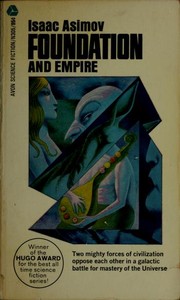
Foundation

Foundation

Isaac Asimov
1951
240 pages · about 4h to read Open Librarygoodreads

Summary

Asimov's Foundation, assembled from stories published between 1942 and 1950, is set in a Galactic Empire in slow decline. Mathematician Hari Seldon develops psychohistory, a statistical science that predicts the behaviour of very large populations while saying nothing about individuals. His calculations show that the Empire will collapse and be followed by thirty thousand years of barbarism, which cannot be prevented, and that a carefully placed intervention can reduce the interregnum to one thousand years.

Seldon establishes two Foundations at opposite ends of the galaxy. The book follows the First Foundation on Terminus through a series of crises, each of which is resolved not by heroism but because the historical forces have narrowed the available options to one. The Foundation survives successively through scientific superiority, religion, trade and economic dependency, with each phase making the previous mechanism obsolete.

The structural interest for a business reader is the treatment of decision-making under determinism. Salvor Hardin's line that violence is the last refuge of the incompetent, and his observation that a Seldon crisis resolves itself once actors stop trying to control it, describe a view in which understanding the constraints matters more than exercising agency.

The book is dated in obvious ways. Women are almost entirely absent, the technology is 1940s extrapolation with nuclear power and no computing, and the characters exist to deliver the arguments. Psychohistory has no plausible basis and Asimov later complicates it with the Mule, an individual who breaks the prediction. Read it for the framework of large-scale forces limiting individual choices.

Key takeaways 8

  1. The behaviour of very large populations can be statistically predictable even when no individual's behaviour is.
  2. A decline that cannot be prevented can still be shortened by a correctly placed intervention at the start.
  3. Institutions preserving knowledge outlast the political structures that created them, which is the Foundation's founding premise.
  4. Each crisis resolves when the available options have narrowed to one, so the correct action is to wait until the constraints have done their work.
  5. Violence is the last refuge of the incompetent, since a party with better options does not need it.
  6. Control mechanisms decay in sequence, so a power that holds through technology will need religion, then trade, then something else.
  7. Any prediction system that depends on populations remaining unaware of the prediction is destroyed by disclosure.
  8. A single sufficiently unusual individual can invalidate a statistical model of history, which Asimov introduces later as the limiting case.

Who should read it

Readers who want a fictional treatment of large-scale forces constraining individual action, widely referenced in technology circles.

Who recommended it 13 · 1 direct

Jeff Bezosreported
Sam Altmanreported

Similar books 6

Chosen by shared topics, the entries that hold them, and the people who recommended both.
T4 Dune
Frank Herbert · 1965

A novel of a feudal space empire fighting over a desert planet and its spice.

Iain M. Banks · 1987

A space opera of a war between the Culture, a machine-run utopia, and its enemies.

Where it sits in the reference 0

No entry holds this book yet. It reached the reference because someone recommended it.

Topics

FictionScience fictionClassic science fiction