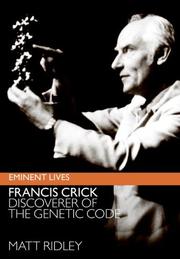
Francis Crick
Francis Crick's life, from a lacklustre education to discovering DNA's structure.
Summary
Ridley writes the life of Francis Crick, co-discoverer of the double helix structure of DNA, who died in 2004 at the age of eighty-eight. Between 1953 and 1966 Crick led a revolution in biology by finding the genetic code, the digital cipher at the centre of heredity. Working always with one partner and doing much of his thinking in conversation, he contributed the double helix, the mechanism of protein synthesis, the three-letter structure of the code and much of the code itself.
Ridley traces Crick's life from a middle-class upbringing in the English Midlands and an undistinguished education, through six years designing magnetic mines for the Royal Navy, to his move into biology at thirty-one. At Cambridge he showed the visual imagination and tenacity that let him see the answers to several great scientific problems before most biologists had seen the problems. Having explained what makes living things alive, he moved to California at sixty to study what makes conscious creatures conscious, and died before finding the answer.
Key takeaways 4
- Crick came to biology late, at thirty-one, after an undistinguished education and wartime work on mines.
- Between 1953 and 1966 he helped work out the double helix, protein synthesis and the genetic code.
- He did much of his best thinking in conversation with a single partner.
- In later life he turned to the problem of consciousness.
Who should read it
Readers who want a short life of one of the great scientists and an account of how the genetic code was found.
About Matt Ridley
British science writer and member of the House of Lords, former chairman of Northern Rock, writing on evolution, genomics, trade and innovation.
The Rational Optimist argues that exchange and specialisation, not individual intelligence, drive rising living standards, and assembles the long-run price and productivity evidence behind the claim. How Innovation Works applies the same method to case histories, showing invention as incremental, collective and largely detached from formal research spending.
Who recommended it 1
Similar books 6
Chosen by shared topics, the entries that hold them, and the people who recommended both.
Twenty-three chapters, one per chromosome, each using a gene to open a subject.
“I highly recommend Genome as well, to figure out the rational basis behind ethics and the origin of virtue.” — Naval Ravikant
Source: Nav.al — 'Matt Ridley: How Innovation Works, Part 2' (Naval's podcast, edited transcript)
Recommended by: Charlie Munger, Mohnish Pabrai and 2 others
An insider's account of the private race to sequence the human genome.
Recommended by: Sam Altman
Innovation is gradual, collective and bottom-up, not the work of lone inventors.
“Matt Ridley, How Innovation Works: And Why It Flourishes in Freedom (New York: Harper, 2020)” — Michael Mauboussin
Source: Increasing Returns: Identifying Forms of Increasing Returns and What Drives Them, page 17
Recommended by: Balaji S. Srinivasan, Michael Mauboussin and 1 other
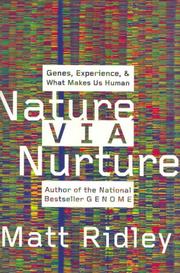
How genes and experience interact, each shaping how the other acts.
Recommended by: Naval Ravikant
Big changes in human affairs emerge from the bottom up rather than by design.
“Everything else written by Matt Ridley. Matt is a scientist, optimist, and forward thinker. One of my favorite authors.” — Naval Ravikant
Source: Naval's Recommended Reading — The Almanack of Naval Ravikant
Recommended by: Naval Ravikant
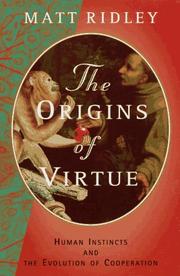
How cooperation and morality evolved from self-interest, via the prisoner's dilemma.
“I really highly, highly recommend picking up Genome, The Red Queen, Origins of Virtue, The Rational Optimist, and The Evolution of Everything.” — Naval Ravikant
Source: The Tim Ferriss Show — Naval Ravikant Q&A, full transcript
Recommended by: Mohnish Pabrai, Naval Ravikant, Ryan Holiday