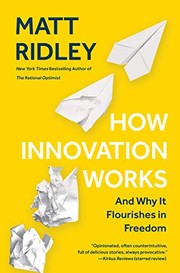
How Innovation Works
Innovation is gradual, collective and bottom-up, not the work of lone inventors.
Innovation as gradual recombination rather than invention.
Summary
Ridley argues that innovation is gradual, incremental, collective and bottom-up, and that the popular account of individual inventors producing breakthroughs is wrong in nearly every case he examines.
His method is a survey of innovations across energy, public health, transport, food, communication and computing, in each case tracing the actual sequence. He documents that most innovations were arrived at simultaneously by multiple people, that the person credited was frequently not the first, that the gap between invention and useful application was usually decades, and that the improvement after the initial invention accounts for most of the value.
His analytical claims include that innovation is distinct from invention and consists of making something useful and affordable; that it emerges from trial and error rather than from theoretical understanding, with the steam engine preceding thermodynamics; that it is a collective process in which no individual understands the whole; and that it requires freedom to experiment and to fail, which is why it concentrates in particular places and periods.
His policy positions follow. He is critical of the patent system, arguing that it obstructs more innovation than it encourages; of the precautionary principle, which he argues has blocked beneficial technologies; and of large-scale government direction, though he acknowledges specific exceptions. Ridley's political commitments shape the argument throughout, and his treatment of publicly funded research understates its role, particularly in computing, biotechnology and the internet. Mariana Mazzucato's work argues the opposite case directly. The historical documentation of simultaneous invention and of the invention to application gap is the substantive material.
Key takeaways 8
- Innovation is distinct from invention and consists of making something useful, reliable and affordable, which is where most of the effort goes.
- Most innovations were arrived at simultaneously by multiple people, which means the credited individual was rarely necessary.
- The gap between an invention and its useful application is usually decades, and the improvements during that period account for most of the value.
- Trial and error precedes theoretical understanding, and the steam engine was working long before thermodynamics explained it.
- Innovation is collective, and no individual understands the whole of any modern technology or supply chain.
- Freedom to experiment and to fail is the condition for innovation, which is why it concentrates in particular places and periods.
- Ridley argues that patents obstruct more innovation than they encourage, which is a contested position stated firmly.
- The treatment of publicly funded research understates its role in computing, biotechnology and the internet, which other scholars argue directly.
Who should read it
Founders and investors who want the case that innovation is incremental and collective, read against accounts that emphasise public funding.
About Matt Ridley
British science writer and member of the House of Lords, former chairman of Northern Rock, writing on evolution, genomics, trade and innovation.
The Rational Optimist argues that exchange and specialisation, not individual intelligence, drive rising living standards, and assembles the long-run price and productivity evidence behind the claim. How Innovation Works applies the same method to case histories, showing invention as incremental, collective and largely detached from formal research spending.
Who recommended it 3 · 3 direct
“Matt Ridley, How Innovation Works: And Why It Flourishes in Freedom (New York: Harper, 2020)”
“It's a must-read for entrepreneurs and government officials who want to either be innovative themselves or foster innovation.”
Similar books 6
Chosen by shared topics, the entries that hold them, and the people who recommended both.
Prosperity grows as trade and specialisation let ideas meet and combine.
“…books I've recommended, highlighted to death, or forced on friends.” — Andrew Wilkinson
Source: Andrew Wilkinson's Bookshelf, neverenough.com
Recommended by: Andrew Wilkinson, Bill Gates, Frank Martin and 12 others
How the internet went from university and military networks to commerce.
Recommended by: Patrick Collison
What happens when technology moves faster than governments can write rules.
Recommended by: Mohnish Pabrai
Big changes in human affairs emerge from the bottom up rather than by design.
“Everything else written by Matt Ridley. Matt is a scientist, optimist, and forward thinker. One of my favorite authors.” — Naval Ravikant
Source: Naval's Recommended Reading — The Almanack of Naval Ravikant
Recommended by: Naval Ravikant

Why some nations prosper, explained by how information and knowledge grow.
Recommended by: Naval Ravikant

Why organisations kill breakthrough projects, and how structure can protect them.
“This book explores the beauty, quirkiness, and complexity of ideas, especially new and out-of-the-box ones.” — Vinod Khosla
Source: 2019 Book Recommendations — Vinod Khosla, Medium
Recommended by: Keith Rabois, Vinod Khosla and 8 others