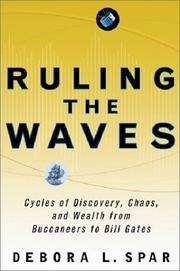
Ruling the Waves
What happens when technology moves faster than governments can write rules.
Summary
Debora Spar examines what happens when technology moves faster than governments and creates markets that, for a while, have no rules. Starting with the compass in the early Middle Ages, she looks at a series of technological revolutions that each promised to transform politics and business: the printing press and maps; the telegraph, radio and satellite television; software, encryption and digital music.
At each turn, Spar argues, invention set off a wave of commerce and a wave of chaos. Entrepreneurs such as Samuel Morse and Rupert Murdoch carved new markets out of the new technology and declared that the old rules no longer applied, and for a time they were right. But eventually even pioneers need rules of property, of coordination and of competition. They turn to government and lobby for order, which sets the stage for the next wave of discovery. Spar tells each chapter as a story and draws parallels between past innovations and the internet era of 2001.
Key takeaways 4
- New technologies create markets that at first have no rules.
- Pioneers such as Morse and Murdoch profit from the early lawlessness.
- Successful pioneers later ask government for property rights and order.
- The cycle repeats from the compass to digital music.
Who should read it
Readers interested in how regulation follows innovation, from navigation to the internet.
Who recommended it 1 · 1 direct
Similar books 6
Chosen by shared topics, the entries that hold them, and the people who recommended both.
How the internet went from university and military networks to commerce.
Recommended by: Patrick Collison
Innovation is gradual, collective and bottom-up, not the work of lone inventors.
“Matt Ridley, How Innovation Works: And Why It Flourishes in Freedom (New York: Harper, 2020)” — Michael Mauboussin
Source: Increasing Returns: Identifying Forms of Increasing Returns and What Drives Them, page 17
Recommended by: Balaji S. Srinivasan, Michael Mauboussin and 1 other

How the wealth of the future will be created and spread.
Recommended by: Ev Williams
How new technologies are changing work, economies and how people relate.
Recommended by: Satya Nadella
The technologies and industries expected to drive the economy next.
Recommended by: Alfred Lin, Reid Hoffman

How the internet changed the way information is produced, and what follows.
Recommended by: Patrick Collison, Mike Maples, Jr.