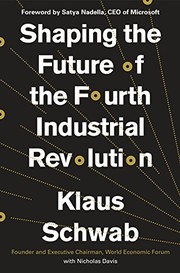
Shaping the Future of the Fourth Industrial Revolution
How new technologies are changing work, economies and how people relate.
Summary
Klaus Schwab, with Nicholas Davis, argues that the Fourth Industrial Revolution is changing how people relate to one another, the work they do, how economies function and what it means to be human, and that its course should be shaped rather than left to emerge. The book asks what people from every background and sector need to know and do to influence how technology transforms the world.
It draws on contributions from more than 200 experts in technology, economics and sociology and is written as a practical guide for citizens, business leaders, social influencers and policy makers. It sets out the main dynamics of the technology revolution, points to stakeholders often left out of discussions of new science, and examines 12 technology areas central to humanity's future, among them artificial intelligence, distributed ledgers and cryptocurrencies, advanced materials and biotechnology. The authors argue that emerging technologies are neither forces beyond human control nor simple tools with known effects, and that today's choices will soon be built into technologies that become part of daily life and of people themselves.
Key takeaways 4
- The Fourth Industrial Revolution affects work, economies and human identity.
- Emerging technologies can be shaped by the choices people make now.
- Schwab and Davis survey 12 technology areas, from AI to biotechnology.
- Overlooked stakeholders need a voice in decisions about technology.
Who should read it
Policy makers and business leaders thinking about the governance of emerging technology.
Who recommended it 1
Similar books 6
Chosen by shared topics, the entries that hold them, and the people who recommended both.

How the wealth of the future will be created and spread.
Recommended by: Ev Williams
What happens when technology moves faster than governments can write rules.
Recommended by: Mohnish Pabrai
The technologies and industries expected to drive the economy next.
Recommended by: Alfred Lin, Reid Hoffman
How the internet changed the way information is produced, and what follows.
Recommended by: Patrick Collison, Mike Maples, Jr.
Why an economy driven by technology traps everyone, and how to remake it for people.
Recommended by: George Hatzis
Essays by consultants and executives on restructuring businesses for the internet.
Recommended by: Mohnish Pabrai