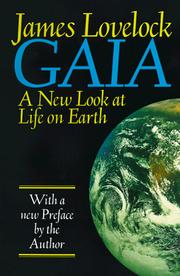
Gaia: A New Look at Life on Earth
The hypothesis that life on Earth behaves as one self-regulating organism.
Summary
The reference has not verified this book in detail; the summary states only what the title, author and subject establish.
James Lovelock explains, for readers without scientific training, his proposal that life on Earth behaves as one organism. The usual view holds that living matter simply suffers whatever threatens it. Lovelock tests a different hypothesis: that the planet's life, along with its air, seas and land surfaces, makes up a complex system that can hold conditions on Earth fit for living things. He searches across time and space for evidence to back this new model of the planet.
The publisher reports that many of Lovelock's predictions have come true since the first edition and that scientists argue hotly over the theory. A new preface in this edition sets out where Lovelock thinks the debate now stands. The detail here rests on the publisher's description alone.
Key takeaways 4
- Lovelock proposes that life and its environment form one system that keeps the Earth habitable.
- He rejects the usual view that living things simply suffer whatever threatens them.
- Air, oceans and land surfaces belong to that system along with living things.
- Many of his predictions have since come true, and scientists still argue over the theory.
Who should read it
General readers interested in Earth science, ecology and big ideas about how the planet works.
Who recommended it 1 · 1 direct
Similar books 6
Chosen by shared topics, the entries that hold them, and the people who recommended both.
How people have used up the Earth's soil for millennia, and what erosion cost them.
Recommended by: Stewart Brand
The species the world is about to lose, and how conservation can pay economically.
Recommended by: Mohnish Pabrai, Stewart Brand
How much of the biosphere's living matter people have taken, measured.
Recommended by: Bill Gates
The geology and climate of the late Quaternary ice age.
Recommended by: Mohnish Pabrai
How scientists came to understand ice ages and their causes.
Recommended by: Charlie Munger
The Earth's biosphere from its origins to its future: physics, chemistry and biology.
Recommended by: Bill Gates