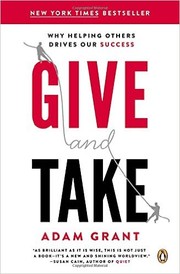
Give and Take
Givers, takers and matchers, and why givers end up both at the bottom and the top.
Reciprocity styles, and how givers outperform over long horizons
Summary
Grant divides people by reciprocity style into givers, who contribute more than they receive; takers, who extract more than they give; and matchers, who balance the two. His finding, drawn from research across sales, medicine, engineering and education, is that givers occupy both the bottom and the top of performance distributions, while takers and matchers cluster in the middle.
The explanation for the bimodal distribution is the book's core. Givers at the bottom are self-sacrificing, meaning they give without regard for their own interests, burn out and are exploited. Givers at the top are what Grant calls otherish, meaning they hold high concern for others and high concern for themselves simultaneously, help in ways that suit their strengths, and set boundaries against exploitation.
The mechanisms he identifies for giver success include broader and more valuable networks built through dormant ties and through helping without expectation; better collaboration, since givers take less credit and are therefore trusted with more; better talent development, since givers invest in people others have written off; and more effective influence through what he calls powerless communication, meaning asking questions and expressing tentativeness, which works better than assertiveness in most professional contexts.
He also covers the five-minute favour, meaning help that costs little and provides substantial value, and the identification of takers through observable signals. The research is Grant's own plus a synthesis of others, and some cited studies have replicated poorly. The three categories are cleaner than actual behaviour. The distinction between self-sacrificing and otherish giving is the practical contribution and answers the obvious objection to the thesis.
Key takeaways 8
- Givers occupy both the bottom and the top of performance distributions, while takers and matchers cluster in the middle.
- The difference between failing and succeeding givers is whether they hold high concern for their own interests alongside concern for others.
- Self-sacrificing giving produces burnout and exploitation, and is a distinct pattern from the giving that produces success.
- Dormant ties, meaning relationships that have lapsed, provide better new information than either close or current contacts.
- Givers develop talent that others overlook, because they invest in people whose potential is not yet visible.
- Asking questions and expressing tentativeness produces more influence in professional settings than assertive advocacy does.
- Small favours that cost the giver little and provide substantial value to the recipient are the efficient form of contribution.
- Takers can be identified from observable behaviour including how they speak about subordinates and how they take credit.
Who should read it
Operators and founders thinking about how helping others affects their own outcomes, particularly the boundary between generosity and exploitation.
About Adam Grant
Organisational psychologist and professor of management at the Wharton School, University of Pennsylvania.
Give and Take presents evidence that people who default to helping others cluster at both the bottom and the top of performance distributions, and identifies what separates the two groups - directly useful for anyone designing incentives or picking partners. Think Again and Originals cover how people revise beliefs against new evidence and how unfamiliar ideas get championed inside established organisations.
Who recommended it 7 · 2 direct
“If you feel you are too generous, or too greedy, or are wary and insist on reciprocation, consider reading this research-based look at the subject of these different personality types. Counter-intuitive findings.”
Similar books 6
Chosen by shared topics, the entries that hold them, and the people who recommended both.
Deliberate practice, not innate talent, explains world-class performance.
“Talent is not innate - it comes from thousands of hours of deliberate practice: focused improving of your shortcomings. That's it. If you can get past the first 20% of the book that just asks questions, the next 60% is quite good.” — Derek Sivers
Source: Derek Sivers book notes (primary, rated list) · Rating: 6/10
Recommended by: Derek Sivers, Michael Mauboussin and 3 others

Gender, emotion and power at work, and how to be rational about emotions.
Recommended by: Diana Kimball

An illustrated guide to handling emotions at work while staying professional.
Recommended by: Cal Newport
People who think ability grows with effort learn more than those who think it fixed.
“One of the reasons I loved Mindset is because it's solutions-oriented.” — Bill Gates
Source: Gates Notes review of Mindset
Recommended by: Bill Gates, Derek Sivers, Michael Mauboussin and 16 others
What makes partnerships succeed, told through the stories of famous pairs.
Recommended by: Mohnish Pabrai
A book of renewal for leaders whose winning at work means losing at life.
Recommended by: Mohnish Pabrai