Updates

  1. Person pages list letters, writing, profiles and links as sortable tables with filters, and show each person's companies as links; Fund letters show each letter's description in its own column.
  2. Experts show a checked job title and a short description of each person; 30 more people have photographs.
  3. Every company, fund, university and publication the experts work for has a page listing the people there.
  4. Fund letters show each letter's thesis and filter by it; 225 person pages list the essays, columns and newsletter issues the person wrote.
  5. Person pages list every essay and newsletter issue a person wrote, and their own books as a table in List view.
  6. Recommends shows the five largest kinds of book and the rest under More; browse pictures load sooner.
  7. Podcasts and talks link the original episode, filter by Audio and video or Press, and list each publisher once.
  8. Pages are wider, Recommends has List and Grid, and a filter clicked again turns off.
  9. Book cards sit in a ruled grid with Open Library and Goodreads links and each book's one-line note.
  10. Funds is now Investors; each investor's styles are buttons that filter the table.
  11. Podcasts and talks on a person's page filter by year and publisher and show as a list or a grid of pictures.
  12. Quotes show only people's own words: 472 summaries written by list sites are gone.
  13. Country pages open from Browse again, and every link on the shelf lands on a page.
  14. Subject and person pages show their sections as tabs, and each book appears once on a person's page.
  15. Book cards show the quote, who said it and the source; grids show five cards to a row.
  16. On a phone, a menu holds the sections, search, Updates, Feedback and dark mode.
  17. Feedback takes a screenshot of the page with no browser prompt, opens a screenshot full size when you click it, and clears itself once sent.
  18. Book cards are centred, search names the topic each book sits in, and any text cut short shows whole on hover.
  19. Search groups its results by kind: people, companies, geographies, subjects, topics, books, funds, fund letters and papers.
  20. The Books table lists who recommended each book by name, and the browser tab names the section you are in.
  21. Feedback can take a screenshot of the page, or one you paste or choose, and opens in the corner beside Updates.
  22. Each rail button reopens its section where you left it, and Browse, Table and People show on every book and subject page.
  23. Filters grey out choices that hold nothing instead of hiding them, and Books › People filters by authors or recommenders.
  24. Feedback takes a subject line and up to three screenshots.
  25. Biographies are grouped by the person they are about: 41 new pages, from Abraham Lincoln to Lee Kuan Yew.
  26. Sport splits into 23 sports, and Religion into one topic per faith.
  27. Book lists show as cards: the cover, one recommendation quote and every recommender by name.
  28. Seventeen subjects that had two or three pages under different names now have one page each.
  29. Every page lists its Experts as authors and recommenders, with a link to them on the Experts tab.
  30. Economics, Financial history, Financial panics and Accounting are subjects of their own, with one page per financial crisis.
  31. Book, person and subject pages open inside the app, so the tabs stay in view.
  32. 996 more book covers, and photographs or logos for 227 more people and companies.
  33. Books › Browse shows every subject as cards, and the rail holds Fund letters, Papers, Experts, Books and Funds.
  34. Every topic over 150 books splits into narrower topics, each with a page of its own.

Send feedback

What is it?
Screenshots, up to 3 (optional)
or paste one with Ctrl+V

We use your email only to reply to you.

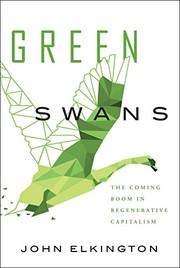
Green Swans

Green Swans

John Elkington
2020
T3 284 pages · about 4h 44m to read Open Librarygoodreads

The author's own recall of the triple bottom line.

Summary

Elkington, who introduced the triple bottom line concept in the 1990s, wrote this as a revision of his own position and an argument about the pace of change required.

His reconsideration is the book's starting point. He had publicly recalled the triple bottom line in 2018, arguing that it had been adopted as an accounting and reporting exercise rather than as the change in business purpose he intended, and that measurement had substituted for transformation. This book develops that.

The green swan of the title inverts Taleb's black swan. A black swan is an unforeseen event with severe negative consequences. A green swan is a change with exponentially positive consequences, produced by the interaction of technology, markets, politics and social pressure reaching a tipping point. Elkington argues that incremental improvement cannot address the scale of the environmental problems and that only such non-linear transitions can, so the practical question is how to create the conditions for them.

He also introduces what he calls ugly ducklings, meaning the early-stage ideas that appear marginal and may become green swans, and argues that organisations should be looking for them rather than optimising existing operations.

The analytical content covers tipping points in systems, the distinction between incremental, disruptive and regenerative change, the concept of exponential progress applied to sustainability, and the failure of existing corporate sustainability practice to produce anything at the required scale.

The book is written by a consultant for an executive audience and is more manifesto than analysis. Its concepts are metaphors rather than mechanisms, and it does not supply a method for identifying which ugly ducklings matter. The self-criticism of the triple bottom line is the most useful part, since it comes from the person best placed to make it.

Key takeaways 7

  1. The triple bottom line was adopted as a reporting exercise rather than as the change in business purpose it was meant to produce.
  2. Measurement substituted for transformation, which the concept's originator publicly acknowledged.
  3. Incremental improvement cannot address problems whose scale requires non-linear change.
  4. A green swan is a change with exponentially positive consequences produced by technology, markets, politics and social pressure reaching a tipping point.
  5. Early-stage ideas that appear marginal are where the non-linear transitions originate, so organisations should be searching for them.
  6. Optimising existing operations produces improvements too small and too slow to matter at the required scale.
  7. The concepts are framing devices rather than mechanisms, and the book supplies no method for identifying which early ideas matter.

Who should read it

Executives working on sustainability who want the originator's own criticism of how the reporting frameworks have been used, treating the rest as manifesto.

Similar books 6

Chosen by shared topics, the entries that hold them, and the people who recommended both.
John Elkington · 1997

The triple bottom line: report on economic, environmental and social results.
Paul Polman, Andrew Winston · 2021

Insider account: Polman on the Sustainable Living Plan years.
Acha Leke, Mutsa Chironga, Georges Desvaux · 2018

McKinsey survey of operating companies; Ghana appears among the consumer-market cases.
Michael Backman · 1999

Written straight after the 1997 crisis on opacity, related-party dealing and family control.

Geoffrey Jones · 2010

Harvard business historian; sets her brand-building against the whole industry.
Tyler Cowen · 2019

A defence of American business on fraud, CEO pay, monopoly and tech, issue by issue.

Where it sits in the reference 3

Business themes
Secular themes
Business themes

Topics

Environment and EnergyBusiness and ManagementClimate change and sustainability