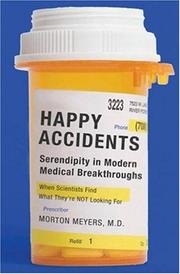
Happy Accidents: Serendipity in Modern Medical Breakthroughs
How chance led to penicillin, chemotherapy and other medical breakthroughs.
Summary
The reference has not verified this book in detail; the summary states only what the title, author and subject establish.
Meyers examines the role of serendipity in the major medical and scientific breakthroughs of the twentieth century. He explains how chance led to the discovery of penicillin, chemotherapy drugs, X-rays, Valium and Viagra, among other advances.
The book was published in 2007. The source read in this pass, a short catalogue description, names the discoveries but not the book's structure or its argument about how research should be organised.
Key takeaways 3
- Many of the twentieth century's major medical advances came from accidents rather than planned research.
- Penicillin, X-rays, Valium and Viagra were all found by chance.
- Recognising an unexpected result is as important as designing an experiment.
Who should read it
Readers interested in the history of medicine and in how discoveries actually happen.
Who recommended it 3 · 2 direct
Similar books 6
Chosen by shared topics, the entries that hold them, and the people who recommended both.
How trivial-seeming questions lead to deeper insight into how science works.
Recommended by: Mohnish Pabrai, Bill Gates
How drug companies distort medical evidence, starting with unpublished trials.
Recommended by: Tim Ferriss
A doctor's exposé of bad science in medicine, the media and alternative cures.
“I think there's a book called Bad Science by Ben Goldacre, who's an MD from the UK. There are a number of chapters that are not relevant to US audience, but it's a helpful book for teaching yourself to think in a structured way, scientifically about medicine.” — Tim Ferriss
Source: The Tim Ferriss Show Transcripts: Dr. Andrew Huberman — Peptides, Performance, and Protocols (#876)
Recommended by: Tim Ferriss
The scientists racing to make the immune system fight cancer: immunotherapy's story.
Recommended by: Vinod Khosla, Keith Rabois
A surgeon's quest to turn the body's immune response against cancer.
Recommended by: Peter Attia