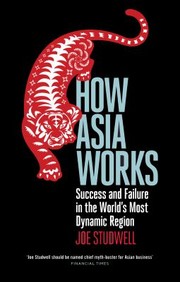
How Asia Works
The state-directed export discipline that produced the Korean chaebol.
Summary
Studwell explains why Japan, South Korea, Taiwan and later China developed successfully while the Philippines, Indonesia, Thailand and Malaysia did not, and gives a three-part policy prescription. He argues the difference was not culture, geography or general openness but a specific sequence of state interventions.
The first stage is land reform. Studwell argues that redistributing land into small owner-operated household farms maximises yield per hectare, because smallholders apply intensive labour that large mechanised farms cannot match, and because this generates a rural surplus and a domestic market at the moment when a country has surplus labour and no capital. The northeast Asian states carried this out and the southeast Asian states did not.
The second is manufacturing policy with export discipline. Studwell argues that infant industry protection is necessary but insufficient, and that the decisive mechanism is forcing protected firms to compete in export markets, which supplies an objective performance test. Firms that failed to export were cut off from subsidised credit and in some cases forced to exit. He contrasts this with Malaysia and Indonesia, where protection was granted without any export requirement and produced permanent rent-seeking.
The third is financial policy subordinating banks to the development strategy, directing credit toward manufacturing and export performance rather than toward consumer lending, property and short-term returns, and controlling capital flows. Studwell argues the standard development advice from the World Bank and IMF got the sequence wrong by recommending premature liberalisation. Critics note that the model requires state capacity that most countries lack, that it produced financial fragility visible in 1997, and that the conditions of the postwar trading system may not be repeatable. The export discipline argument is the most durable contribution.
Key takeaways 8
- Redistributing land into small owner-operated farms maximises output per hectare and generates the rural surplus that funds early industrialisation.
- Yield per hectare rather than output per worker is the correct objective for a country with surplus labour and scarce capital.
- Infant industry protection works only when combined with export discipline, which provides an objective test of whether the protected firm is becoming competitive.
- Governments must be willing to cut off subsidised credit and force the exit of firms that fail the export test, and the willingness to do this separates success from failure.
- Banks must be directed toward manufacturing and export performance rather than left to allocate credit toward property and consumer lending.
- Capital controls are necessary during the development phase because open capital accounts push resources toward short-term returns.
- The southeast Asian states protected industries without imposing export requirements, which produced rent-seeking rather than capability.
- Standard liberalisation advice recommends the right policies in the wrong sequence, applying them before the industrial base exists to survive them.
Who should read it
Investors and policy-minded readers examining emerging market development, who want a specific mechanism rather than general claims about institutions.
About Joe Studwell
Journalist and author on East Asian business and development; founding editor of the China Economic Quarterly.
How Asia Works argues that Japan, Korea, Taiwan and China grew by sequencing three policies - household-scale land reform, export discipline imposed on manufacturers, and finance directed to both - and explains why Southeast Asian states that skipped the sequence stalled. Asian Godfathers documents how the region's tycoon conglomerates earn returns from licences, property and cheap deposits rather than from operating skill.
Who recommended it 3 · 2 direct
“it's a good read for anyone who wants to understand what actually determines whether a developing economy will succeed.”
Similar books 6
Chosen by shared topics, the entries that hold them, and the people who recommended both.
Why foreign investors' hopes of profit in 1990s China were mostly disappointed.
How Southeast Asia's tycoons got rich from political favours, not productivity.
How Singapore's leaders chose policies, from courting multinationals onward.
Recommended by: Balaji S. Srinivasan, Mohnish Pabrai and 1 other

How chips became the key to economic and military power, made in a few chokepoints.
Recommended by: Andrew Wilkinson

Twenty-five years negotiating with Chinese officials, from Goldman to the Treasury.
Recommended by: Mohnish Pabrai, Anthony Pompliano and 1 other

How Taiwan moved into higher-value industries after its first industrialisation.
Where it sits in the reference 12
Topics