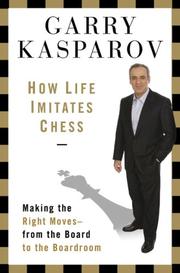
How Life Imitates Chess
A former world chess champion uses his games as a guide to success in life.
Summary
The reference has not verified this book in detail; the summary states only what the title, author and subject establish.
Kasparov, a former world chess champion, uses his experience of winning at chess as a guide to succeeding in life. He recounts many events from his chess career to illustrate his points about decision-making, strategy and success.
The book was published in 2007. The source read in this pass, a short Wikipedia article, does not set out its chapters or the specific lessons Kasparov draws.
Key takeaways 3
- Kasparov treats the methods of championship chess as transferable to decisions outside the game.
- Episodes from his career serve as case studies in strategy.
- Success in any field rests on habits of thought that can be studied and improved.
Who should read it
Readers interested in strategy and decision-making who want a world champion's view.
Who recommended it 2 · 2 direct
“Endnotes Garry Kasparov, How Life Imitates Chess: Making the Right Moves—from the Board to the Boardroom (New York: Bloomsbury, 2007), 166”
Similar books 6
Chosen by shared topics, the entries that hold them, and the people who recommended both.
People can't act randomly, and how to exploit that in games, tests and markets.
Recommended by: Mohnish Pabrai
How people learned to measure risk, from early probability to portfolio theory.
“(Risk is the subject of Peter Bernstein’s wonderful new book, Against the Gods: The Remarkable Story of Risk.)” — Bill Miller
Source: 1996 Q3 Market Commentary
Recommended by: Bill Miller, Charles de Vaulx, Howard Marks and 9 others
How snap judgments work, when to trust them and when they mislead.
“Malcolm Gladwell, Blink: The Power of Thinking Without Thinking (New York: Little, Brown and Company, 2005)” — Michael Mauboussin
Source: Are You an Expert? Experts and Markets, page 9
Recommended by: Michael Mauboussin, Mohnish Pabrai and 2 others
Whether clinical judgement or statistical formulas predict better in psychology.
“Paul E. Meehl, Clinical versus Statistical Prediction: A Theoretical Analysis and a Review of the Evidence (Minneapolis, MN: University of Minnesota Press, 1954)” — Michael Mauboussin
Source: BIN There, Done That: How to Reduce the Sources of Forecasting Error, page 14
Recommended by: Michael Mauboussin, Daniel Kahneman
Game theory applied to business, which is cooperative and competitive at once.
“Adam M. Brandenburger and Barry J. Nalebuff, Co-opetition (New York: Currency Doubleday, 1996)” — Michael Mauboussin
Source: The Ecosystem Edge, page 10
Recommended by: Michael Mauboussin, Mohnish Pabrai
Four traps that ruin decisions, such as narrow framing, and a process to beat each.
“Interesting and insightful dive into the subject of how to make big decisions. Specific useful advice.” — Derek Sivers
Source: Derek Sivers book notes (primary, rated list) · Rating: 8/10
Recommended by: Andrew Wilkinson, Derek Sivers and 6 others
Where it sits in the reference 1
Topics 2
As an Amazon Associate I earn from qualifying purchases.