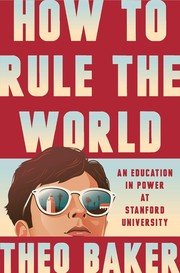
How to Rule the World
A student journalist's account of Silicon Valley hubris as seen from Stanford.
Summary
Theo Baker won the George Polk Award for the investigation that brought down Stanford's president, and here gives an account of Silicon Valley hubris as seen from the university. He arrived at Stanford at seventeen as a tech-obsessed coder and found what seemed a paradise, with Rodin sculptures beside nuclear laboratories and inventors lounging with Olympians.
He soon discovered a culture that embraced corner-cutting and gave excess and access to young people with few safeguards against bad behaviour: slush funds, shell companies and yacht parties. Stanford, he argues, was less a school than a business, with an annual budget nearly twice that of Harvard or Yale and larger than those of 116 countries, and its product was students, especially the few marked as future founders of trillion-dollar start-ups, who were courted with secret societies, "pre-idea" funding offers and calls from billionaires. Joining the student newspaper, Baker began examining the record of the president, Marc Tessier-Lavigne, a neuroscientist and biotech executive, and found unreported allegations of research misconduct in studies across two decades.
Key takeaways 4
- Stanford operates more like a business than a school, in Baker's account.
- Promising students are courted with money and access before they have ideas.
- Silicon Valley's culture tolerates corner-cutting among its favoured young people.
- A student journalist uncovered misconduct allegations that ended a university president's tenure.
Who should read it
Readers interested in Silicon Valley, elite universities and investigative journalism.
Who recommended it 1 · 1 direct
Similar books 6
Chosen by shared topics, the entries that hold them, and the people who recommended both.
How leading universities began giving away their course materials online.
Recommended by: Bill Gates
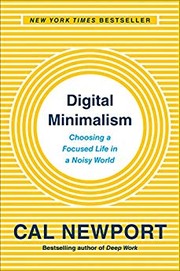
Why living well with technology means spending much less time using it.
“I finally got around to reading his most recent book, Digital Minimalism: Choosing a Focused Life in a Noisy World and my friends were correct. Newport is famous for being a millennial, computer scientist, and a book author who doesn’t have a social media account. Digital Minimalism is complementary to Jaron Lanier‘s book Ten Arguments for Deleting Your Social Media Accounts Right Now, but I found Newport a lot more comfortable and convincing.” — Brad Feld
Source: Book: Digital Minimalism — Feld Thoughts
Recommended by: Brad Feld, Nat Eliason, Alex Lieberman and 1 other
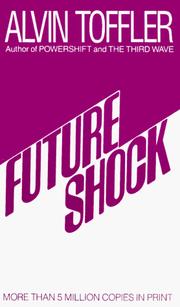
How too much change in too short a time strains people and whole societies.
“Future Shock did not disappoint me – it was stunningly interesting, even 40 years later.” — Brad Feld
Source: Book: Future Shock — Feld Thoughts
Recommended by: Brad Feld, Howard Marks, Kevin Kelly and 1 other
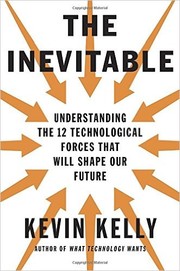
The technology trends that will reshape daily life over the next thirty years.
“What are today's technologies inevitably going to lead to? Great predictions. Half of it was super-inspiring, painting a vision of the future that made me want to jump on it. Half felt like “well, duh, obviously!” maybe because I'm already deep in it.” — Derek Sivers
Source: Derek Sivers book notes (primary, rated list) · Rating: 7/10
Recommended by: Derek Sivers, Nat Eliason, Patrick Collison and 2 others
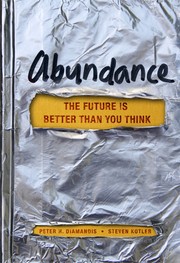
The case that fast-improving technology will make scarce resources cheap.
Recommended by: Bill Gates, Richard Branson, Morgan Housel and 2 others
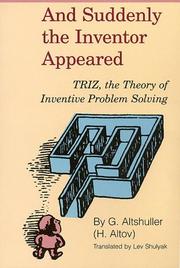
TRIZ, a method for solving technical problems through invention.
Recommended by: Patrick Collison