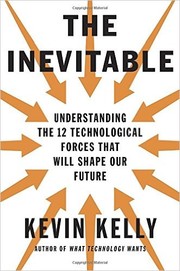
The Inevitable
The technology trends that will reshape daily life over the next thirty years.
Summary
Kelly, a technology writer, argues that much of what will happen over the next thirty years is already set in motion by long-term technological trends. He names twelve forces and gives each a chapter title in verb form: becoming, cognifying, flowing, screening, accessing, sharing, filtering, remixing, interacting, tracking, questioning and beginning. He treats them as overlapping and dependent on one another.
From these forces he projects changes in daily life, from virtual reality in the home to an on-demand economy and artificial intelligence built into every manufactured product. He argues that the forces will change how people buy, work, learn and communicate. Kelly's view is optimistic: a person or firm that understands the trends can decide earlier what to build, where to work and what to invest in, and can arrange its use of technology to gain the most from it. He separates the general direction of a trend, which he calls inevitable, from the specific products that come out of it, which are not.
Key takeaways 4
- Long-term technological trends already in motion set the direction of the next thirty years.
- Kelly names twelve forces, among them cognifying, flowing, sharing, remixing and tracking.
- The forces overlap and depend on one another rather than acting alone.
- Understanding the trends early helps decide what to build, where to work and what to invest in.
Who should read it
Investors and founders who want a structured view of the technology trends that may shape markets over the coming decades.
About Kevin Kelly
Founding executive editor of Wired and earlier editor of the Whole Earth Review; writes on technology and its long-run direction.
Out of Control described decentralised and emergent systems - swarms, networks, co-evolution, systems that improve without a controller - in 1994, well before platform and marketplace businesses were built on those properties. The Inevitable names twelve ongoing technological shifts, including the move from ownership to access and from products to continuously updated services, which is the frame a large share of software and marketplace theses now assume.
Who recommended it 5 · 3 direct
“What are today's technologies inevitably going to lead to? Great predictions. Half of it was super-inspiring, painting a vision of the future that made me want to jump on it. Half felt like “well, duh, obviously!” maybe because I'm already deep in it.”
Similar books 6
Chosen by shared topics, the entries that hold them, and the people who recommended both.
How humanity and technology together keep widening the opportunities open to people.
“Fascinating historical and philosophical perspective on technology, where it's come from, where it's going.” — Derek Sivers
Source: Derek Sivers book notes (primary, rated list) · Rating: 8/10
Recommended by: Derek Sivers, Patrick Collison and 2 others


How networked thinking can transform government, research and the arts.
Recommended by: Patrick Collison, Ev Williams

How too much change in too short a time strains people and whole societies.
“Future Shock did not disappoint me – it was stunningly interesting, even 40 years later.” — Brad Feld
Source: Book: Future Shock — Feld Thoughts
Recommended by: Brad Feld, Howard Marks, Kevin Kelly and 1 other

The wide-reaching effects of the internet on how people come together.
“Like Wikinomics and Crowdsourcing, required reading if interested in harnessing the collective power of people online.” — Derek Sivers
Source: Derek Sivers book notes (primary, rated list) · Rating: 6/10
Recommended by: David Perell, Derek Sivers, Ryan Holiday and 2 others

How the internet let amateurs topple old professions such as lawyers and stock gurus.
Recommended by: Nat Eliason, Ryan Holiday