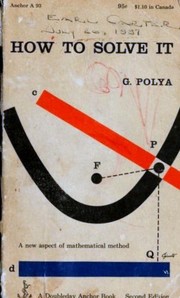
How to Solve It: A New Aspect of Mathematical Method
A guide to the method of solving mathematical problems.
Summary
George Pólya's guide to problem solving came out from Princeton University Press in 1945, and Doubleday issued a second edition in 1957. Pólya says in his first preface that he wrote mainly for mathematics teachers and their students, and he drew his examples from elementary algebra and geometry. Other disciplines later took it up because it explains heuristics so clearly: induction, analogy, specialisation, working backwards and similar strategies. It has appeared in more than 15 languages and has sold more than a million copies.
A two-page checklist at the start divides the work into four phases: understand the problem, make a plan, carry it out and look back. Pólya insists the boundaries between phases are loose, since a solver's view of a problem shifts as the work goes on. Many students get stuck, he writes, only because they have not fully understood what is asked, so a teacher should lead them with questions such as "What is the unknown?" and "What are the data?". The publisher presents the method of proving a result or finding an unknown as a help with any problem open to reasoning, whether building a bridge or winning at anagrams, by cutting out what is irrelevant and going to the core of the problem.
Key takeaways 4
- Pólya splits problem solving into four phases: understand, plan, carry out, look back.
- Many students fail because they have not fully understood the problem.
- Heuristics such as analogy, specialisation and working backwards help a solver find a plan.
- Teachers should guide students with questions rather than hand them answers.
Who should read it
Students and teachers of mathematics, and anyone who wants a method for solving problems.
Who recommended it 1 · 1 direct
Similar books 6
Chosen by shared topics, the entries that hold them, and the people who recommended both.
Problems, strategies and techniques for skill at mathematical problem solving.
Recommended by: Patrick Collison
How to learn maths and science, from the course Learning How to Learn.
“Thought I was getting a book about math, but ended up being a surprisingly good book about learning in general. Main points are about diffused thinking vs focused thinking.” — Derek Sivers
Source: Derek Sivers book notes (primary, rated list) · Rating: 8/10
Recommended by: Derek Sivers, Mohnish Pabrai
Why mathematics is worth doing for its beauty, apart from any use.
Recommended by: Patrick Collison, Paul Graham
The history of the number e, from compound interest to the Gateway Arch.
Recommended by: Patrick Collison
The mathematicians whose logic led to the computer.
Recommended by: Patrick Collison
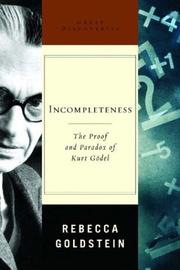
The life and thought of Kurt Gödel, whose theorems changed mathematics.
Recommended by: Patrick Collison