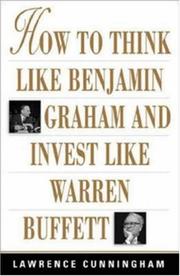
How to Think Like Benjamin Graham and Invest Like Warren Buffett
Summary
Cunningham, a law professor who edited The Essays of Warren Buffett, wrote this as a bridge between Graham's analytical framework and Buffett's application of it, aimed at readers who want the reasoning rather than formulas.
His organising argument concerns what he calls information anxiety: investors face more data than they can use and less genuine information than they need, and the response is either paralysis or dependence on intermediaries who profit from the dependence. His answer is a framework for deciding what actually matters.
The content covers Graham's core positions on the distinction between investment and speculation, on the margin of safety and on treating shares as fractional business ownership; the critique of efficient market theory and of beta as a risk measure, arguing that risk is the probability of permanent loss rather than price variability; the analysis of financial statements including the specific places where reported figures diverge from economic reality, on which Cunningham's legal and accounting background is useful; the assessment of management on capital allocation and candour; and the valuation approaches available, with an honest treatment of their limits.
He also covers the legal and governance context, including directors' duties, disclosure obligations and what an outside shareholder can and cannot compel, which most investment books omit and which Cunningham is well placed to explain.
The book is derivative by design, since it presents other people's frameworks. Its contribution is the organisation and the legal and accounting depth. Graham and Buffett's own writing remains the primary source.
Key takeaways 7
- Risk is the probability of permanent loss of capital rather than the variability of price, and using price variability as the measure directs attention away from what matters.
- Investors face more data than they can use and less genuine information than they need, which produces dependence on intermediaries who profit from it.
- Shares should be analysed as fractional ownership of a business, which determines what information is relevant and what can be ignored.
- Reported financial figures diverge from economic reality at identifiable points, and knowing where those points are is most of financial statement analysis.
- Management should be assessed on capital allocation decisions and on candour about mistakes, both of which are observable from public documents over years.
- Valuation methods each carry assumptions that determine their output, and an investor should know which assumption their answer depends on.
- Outside shareholders have limited legal ability to compel management action, which is why assessing management before investing matters more than engaging afterwards.
Who should read it
Investors who want Graham and Buffett's frameworks organised together with unusual depth on the legal and accounting context.
About Lawrence A. Cunningham
Corporate-governance scholar and longtime George Washington University law professor; edits The Essays of Warren Buffett and writes on Berkshire and quality investing.
The Essays of Warren Buffett reorganises decades of Berkshire shareholder letters by subject - governance, accounting, mergers, valuation - turning scattered annual commentary into a usable manual. The later books extend the analysis to Berkshire's decentralised structure and to the traits that make a business durable enough to hold for decades.
University of Delaware, Quality Shareholders Group, George Washington University
Who recommended it 1 · 1 direct
Similar books 6
Chosen by shared topics, the entries that hold them, and the people who recommended both.
Berkshire's shareholder letters arranged by topic: governance, valuation, mergers.
“The resource is as valuable as Larry Cunningham's The Essays of Warren Buffett, which similarly organizes by subject matter” — Christopher Bloomstran
Source: Semper Augustus 2024 Letter to Clients, 'Books and Tunes for Walking', p. 96
Recommended by: Christopher Bloomstran, Francois Rochon and 11 others
Updates Graham and Dodd's valuation method for modern financial statements
Recommended by: Mohnish Pabrai
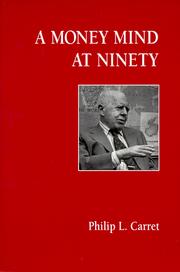
A fund manager of sixty years on investing, business and a long life.
Recommended by: Mohnish Pabrai
Stock prices follow a random walk, so a low-cost index fund beats stock picking.
Recommended by: Nat Eliason, Mohnish Pabrai
Recommended by: Mohnish Pabrai
Berkshire as an operating company: its subsidiaries' culture and whether it lasts.
Recommended by: Mohnish Pabrai
Where it sits in the reference 2
Topics