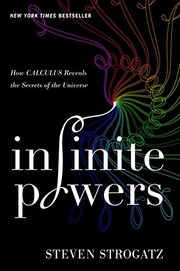
Infinite Powers
How calculus works and how it made modern technology possible.
Calculus explained as the mathematics of change
Summary
Strogatz, author of The Joy of x, explains calculus through its history and argues that it is a subject about simplicity rather than complexity. Calculus uses an unreal number, infinity, to solve real problems: it breaks a hard problem into easier ones and then reassembles the answers. Without it, he writes, there would be no mobile phones, television, GPS or ultrasound, DNA would not have been decoded and Neptune would not have been found.
The history runs from the first signs of calculus in ancient Greece to the discovery of gravitational waves, which calculus had predicted. Strogatz shows how the method met the problems of each age: finding the area of a circle with only sand and a stick, explaining why Mars sometimes appears to move backwards, generating electricity with magnets, keeping a rocket on course for the Moon and turning the tide against AIDS. He calls calculus the language of the universe and sets out its principles for readers who were put off the subject at school.
Key takeaways 4
- Calculus solves hard problems by cutting them into easy pieces and reassembling the answers.
- Infinity, though unreal, is the tool that makes those calculations work.
- Calculus answered practical problems in every age, from planetary motion to electricity and spaceflight.
- Much modern technology, from GPS to ultrasound, rests on calculus.
Who should read it
Readers who want to understand calculus as the mathematics of change without returning to a textbook.
Who recommended it 2
Similar books 6
Chosen by shared topics, the entries that hold them, and the people who recommended both.
How the sciences and humanities can be unified by causal links from physics up.
“I was inspired by E. O. Wilson's book Consilience, which came out in 1998 and is a book I'd recommend.” — Michael Mauboussin
Source: MOI Global interview with Michael Mauboussin
Recommended by: Michael Mauboussin, Mohnish Pabrai

Early specialisation works only where rules are stable; elsewhere breadth wins.
“In the book Range: Why Generalists Triumph in a Specialist World2, author David Epstein argues that many fields have gone so overboard with specialization that generalists are now the more valuable problem solvers.” — Bill Nygren
Source: Bill Nygren Market Commentary | 2Q19
Recommended by: Bill Gates, Bill Nygren, Michael Mauboussin and 12 others
How shared fictions such as money, nations and gods let humans cooperate at scale.
“…books I've recommended, highlighted to death, or forced on friends.” — Andrew Wilkinson
Source: Andrew Wilkinson's Bookshelf, neverenough.com
Recommended by: Andrew Wilkinson, Bill Gates, David Perell and 40 others
Six physics lectures with little maths: atoms, energy, gravity and quantum behaviour.
Recommended by: Naval Ravikant

Knowledge can grow without limit through good explanations that are hard to vary.
“Favorites, I would say David Deutsch, "The Beginning of Infinity" is definitely one of my favorites.” — Albert Wenger
Source: Transcript: Albert Wenger
Recommended by: Albert Wenger, Derek Sivers and 9 others

Reality through four strands: many-worlds physics, computation, evolution, Popper.
Recommended by: Naval Ravikant, Patrick Collison and 4 others
Where it sits in the reference 1
Topics 2
As an Amazon Associate I earn from qualifying purchases.