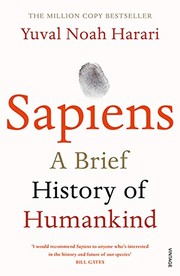
Sapiens
How shared fictions such as money, nations and gods let humans cooperate at scale.
Big history of money, trade and the shared fictions that organise markets
Summary
Harari tells the history of Homo sapiens in four movements: the cognitive revolution about seventy thousand years ago, the agricultural revolution about twelve thousand years ago, the unification of humankind under money, empire and religion, and the scientific revolution from about 1500. His central mechanism is shared fiction. Large numbers of strangers cooperate because they believe in things that exist only in collective imagination, including gods, nations, money, human rights and limited liability companies.
The evidence is synthesised from archaeology, evolutionary biology, anthropology and economic history rather than from original research. Harari is willing to state contrarian positions bluntly. He calls the agricultural revolution history's biggest fraud, arguing that wheat domesticated humans into longer hours and worse diets while allowing populations to grow. He treats the scientific revolution as a discovery of ignorance, in which Europeans admitted they did not know things and organised expeditions, capital and empire to find out.
For investors and operators the useful part is the account of money and corporations as intersubjective realities that hold only because enough people act as if they hold. Harari's treatment of credit as a claim on an imagined future explains why economies can grow when everyone believes growth will continue. His chapters on imperial and capitalist expansion connect financing, science and conquest as one system.
Historians dispute much of the detail. Specialists have criticised his account of forager happiness, his confident claims about cognitive change, and his tendency to state debated positions as settled. The book compresses enormous literatures and rarely shows readers where the disagreements lie. Read it for the framework of shared fiction rather than as a reliable reference on any single period.
Key takeaways 8
- Large-scale human cooperation depends on shared fictions such as money, nations and corporations, which exist only because enough people believe in them.
- The agricultural revolution increased the number of humans while making individual lives harder, so it benefited the species at the cost of the individual.
- Money works as the most universal system of mutual trust ever devised, because it converts anything into anything and reaches across cultures that share nothing else.
- Empires spread by absorbing and standardising cultures, and most cultural inheritance people now defend was itself imposed by an earlier empire.
- The scientific revolution began with an admission of ignorance, which made systematic investigation and its funding possible.
- Credit and the expectation of future growth allowed capitalism to finance projects out of wealth that did not yet exist.
- Increases in collective human power have not produced matching increases in individual wellbeing.
- Biological engineering and artificial intelligence may end Homo sapiens as a species, replacing it with something designed rather than evolved.
Who should read it
Readers who want one framework connecting institutions, money and belief across all of human history, useful as background thinking rather than as a source of facts.
Who recommended it 43 · 17 direct
“…books I've recommended, highlighted to death, or forced on friends.”
“I would recommend this book to anyone interested in a fun, engaging look at early human history.”
“I resisted reading this popular history of mankind, because it came out when I had just finished “Guns, Germs, and Steel” and “Cows, Pigs, Wars, and Witches”, on the same subject. But wow - this book is at its best when the author is sharing his personal perspective about binding myths, humanism, and other ways that “truths” are not true. And you get an interesting history of the world along with it. Strange mix of history and philosophy.”
“I'm rereading Sapiens again, because I love that book so much.”
Similar books 6
Chosen by shared topics, the entries that hold them, and the people who recommended both.

Why Eurasian societies conquered others: the role of geography, crops and animals.
“This is an insightful read on the pace at which societies develop and why.” — Christopher Bloomstran
Source: Semper Augustus 2023 Letter to Clients, 'Worldly Wisdom', p. 81
Recommended by: Charlie Munger, Christopher Bloomstran and 17 others
Why startups should build something new and own a small market before growing.
“Inspired by modern tech classics like Zero to One and The Hard Thing About Hard Things, I wrote the book to be succinct, thorough, and accessible.” — Chris Dixon
Source: I wrote a book: Read Write Own — cdixon
Recommended by: Balaji S. Srinivasan, Chris Dixon and 38 others

What humanity may seek after famine, plague and war: immortality and divinity.
“Very interesting alternative perspective on life from a historian. Anti-religion, anti-humanism, pro-animal. Seems detached, but is quite opinionated. Much to think about, regardless. My notes here give a taste. A lot to think about.” — Derek Sivers
Source: Derek Sivers book notes (primary, rated list) · Rating: 6/10
Recommended by: Andrew Wilkinson, Bill Gates, Derek Sivers and 8 others

Knowledge can grow without limit through good explanations that are hard to vary.
“Favorites, I would say David Deutsch, "The Beginning of Infinity" is definitely one of my favorites.” — Albert Wenger
Source: Transcript: Albert Wenger
Recommended by: Albert Wenger, Derek Sivers and 9 others
Recurring patterns drawn from world history: biology, morals, religion, economics.
“…books I've recommended, highlighted to death, or forced on friends.” — Andrew Wilkinson
Source: Andrew Wilkinson's Bookshelf, neverenough.com
Recommended by: Andrew Wilkinson, Balaji S. Srinivasan and 14 others

Why some things gain from volatility and disorder, and how to build them.
“Antifragile. Loved the first 1/3 and last 1/3 of this book.” — Andrew Chen
Source: Books I’m reading (2013)
Recommended by: Ana Fabrega, Andrew Chen, Derek Sivers and 24 others
Where it sits in the reference 3
Topics 2
As an Amazon Associate I earn from qualifying purchases.