Updates

  1. Person pages list letters, writing, profiles and links as sortable tables with filters, and show each person's companies as links; Fund letters show each letter's description in its own column.
  2. Experts show a checked job title and a short description of each person; 30 more people have photographs.
  3. Every company, fund, university and publication the experts work for has a page listing the people there.
  4. Fund letters show each letter's thesis and filter by it; 225 person pages list the essays, columns and newsletter issues the person wrote.
  5. Person pages list every essay and newsletter issue a person wrote, and their own books as a table in List view.
  6. Recommends shows the five largest kinds of book and the rest under More; browse pictures load sooner.
  7. Podcasts and talks link the original episode, filter by Audio and video or Press, and list each publisher once.
  8. Pages are wider, Recommends has List and Grid, and a filter clicked again turns off.
  9. Book cards sit in a ruled grid with Open Library and Goodreads links and each book's one-line note.
  10. Funds is now Investors; each investor's styles are buttons that filter the table.
  11. Podcasts and talks on a person's page filter by year and publisher and show as a list or a grid of pictures.
  12. Quotes show only people's own words: 472 summaries written by list sites are gone.
  13. Country pages open from Browse again, and every link on the shelf lands on a page.
  14. Subject and person pages show their sections as tabs, and each book appears once on a person's page.
  15. Book cards show the quote, who said it and the source; grids show five cards to a row.
  16. On a phone, a menu holds the sections, search, Updates, Feedback and dark mode.
  17. Feedback takes a screenshot of the page with no browser prompt, opens a screenshot full size when you click it, and clears itself once sent.
  18. Book cards are centred, search names the topic each book sits in, and any text cut short shows whole on hover.
  19. Search groups its results by kind: people, companies, geographies, subjects, topics, books, funds, fund letters and papers.
  20. The Books table lists who recommended each book by name, and the browser tab names the section you are in.
  21. Feedback can take a screenshot of the page, or one you paste or choose, and opens in the corner beside Updates.
  22. Each rail button reopens its section where you left it, and Browse, Table and People show on every book and subject page.
  23. Filters grey out choices that hold nothing instead of hiding them, and Books › People filters by authors or recommenders.
  24. Feedback takes a subject line and up to three screenshots.
  25. Biographies are grouped by the person they are about: 41 new pages, from Abraham Lincoln to Lee Kuan Yew.
  26. Sport splits into 23 sports, and Religion into one topic per faith.
  27. Book lists show as cards: the cover, one recommendation quote and every recommender by name.
  28. Seventeen subjects that had two or three pages under different names now have one page each.
  29. Every page lists its Experts as authors and recommenders, with a link to them on the Experts tab.
  30. Economics, Financial history, Financial panics and Accounting are subjects of their own, with one page per financial crisis.
  31. Book, person and subject pages open inside the app, so the tabs stay in view.
  32. 996 more book covers, and photographs or logos for 227 more people and companies.
  33. Books › Browse shows every subject as cards, and the rail holds Fund letters, Papers, Experts, Books and Funds.
  34. Every topic over 150 books splits into narrower topics, each with a page of its own.

Send feedback

What is it?
Screenshots, up to 3 (optional)
or paste one with Ctrl+V

We use your email only to reply to you.

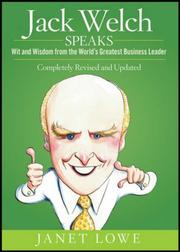
Jack Welch Speaks: Wisdom from the World's G

Jack Welch Speaks: Wisdom from the World's Greatest Business Leader

Janet Lowe
1998
T3 280 pages · about 4h 40m to read Open Librarygoodreads

Summary

Lowe assembled quotations from Jack Welch drawn from his speeches, letters to General Electric shareholders, interviews and internal communications, organised by topic with brief connecting commentary.

The positions collected cover Welch's stated management doctrine: that a business should be first or second in its market or be fixed, sold or closed; that boundarylessness means removing the barriers between functions, between the company and its suppliers and customers, and between countries; that Work-Out sessions in which employees present problems and managers must decide on the spot removes bureaucracy; that ranking employees and removing the bottom ten percent annually maintains organisational quality; that candour is the scarcest quality in large organisations; that a manager who delivers results without living the values is the difficult case and must nonetheless go; and that the objective is speed, simplicity and self-confidence.

The format is a compilation of quotations rather than analysis, which means the positions are stated without the context that would let a reader assess them and without any examination of whether they produced the results claimed.

The reference has not verified the sourcing of individual quotations. The title's claim about the world's greatest business leader reflects the 1998 consensus, which has since been substantially revised, particularly regarding GE Capital's role in reported earnings and the company's subsequent collapse. Welch's own Jack: Straight from the Gut states his positions directly, and David Gelles' The Man Who Broke Capitalism supplies the critical assessment.

Key takeaways 7

  1. A business should be first or second in its market or be fixed, sold or closed, which was the portfolio rule Welch applied across General Electric.
  2. Boundarylessness means removing barriers between functions, between the company and its suppliers and customers, and across countries.
  3. Ranking employees and removing the bottom tier annually was Welch's stated method for maintaining organisational quality.
  4. A manager who delivers results while violating the stated values is the difficult case, and Welch held that they must nonetheless be removed.
  5. Candour is the scarcest quality in large organisations, and its absence is what allows problems to persist unaddressed.
  6. Bureaucracy is removed by requiring managers to decide on presented problems immediately rather than through review processes.
  7. The book is a compilation of quotations without context or assessment, and the consensus it reflects about Welch has been substantially revised since.

Who should read it

Readers wanting Welch's stated positions compiled, with his own memoir and the critical literature as the substantive sources.

About Janet Lowe

American financial journalist and biographer of Charlie Munger, Benjamin Graham, Warren Buffett and Bill Miller.

Damn Right! is the standard full-length life of Charlie Munger, built from interviews with Munger, his family and his partners, and the Graham volumes put writings and lectures that had gone out of print back in circulation. The books supply the biographical record behind quotations that circulate everywhere else without sources.

Who recommended it 1 · 1 direct

Similar books 6

Chosen by shared topics, the entries that hold them, and the people who recommended both.
Bryce G. Hoffman · 2012

The 2006-2010 turnaround told with close management access.

Recommended by: Mohnish Pabrai
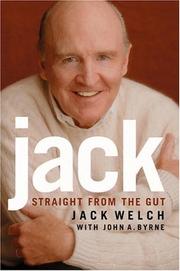
Jack Welch, John A. Byrne · 2001

Running General Electric from 1981 to 2001, as told on retiring.

Alan C. Greenberg · 1996

Greenberg's own memos; the cost culture Bear ran on before it broke.

Recommended by: Mohnish Pabrai, Jeff Bezos
Where it sits in the reference 3

Journalists
Business themes
Business themes

Topics

Business and ManagementLeadership