Updates

  1. Person pages list letters, writing, profiles and links as sortable tables with filters, and show each person's companies as links; Fund letters show each letter's description in its own column.
  2. Experts show a checked job title and a short description of each person; 30 more people have photographs.
  3. Every company, fund, university and publication the experts work for has a page listing the people there.
  4. Fund letters show each letter's thesis and filter by it; 225 person pages list the essays, columns and newsletter issues the person wrote.
  5. Person pages list every essay and newsletter issue a person wrote, and their own books as a table in List view.
  6. Recommends shows the five largest kinds of book and the rest under More; browse pictures load sooner.
  7. Podcasts and talks link the original episode, filter by Audio and video or Press, and list each publisher once.
  8. Pages are wider, Recommends has List and Grid, and a filter clicked again turns off.
  9. Book cards sit in a ruled grid with Open Library and Goodreads links and each book's one-line note.
  10. Funds is now Investors; each investor's styles are buttons that filter the table.
  11. Podcasts and talks on a person's page filter by year and publisher and show as a list or a grid of pictures.
  12. Quotes show only people's own words: 472 summaries written by list sites are gone.
  13. Country pages open from Browse again, and every link on the shelf lands on a page.
  14. Subject and person pages show their sections as tabs, and each book appears once on a person's page.
  15. Book cards show the quote, who said it and the source; grids show five cards to a row.
  16. On a phone, a menu holds the sections, search, Updates, Feedback and dark mode.
  17. Feedback takes a screenshot of the page with no browser prompt, opens a screenshot full size when you click it, and clears itself once sent.
  18. Book cards are centred, search names the topic each book sits in, and any text cut short shows whole on hover.
  19. Search groups its results by kind: people, companies, geographies, subjects, topics, books, funds, fund letters and papers.
  20. The Books table lists who recommended each book by name, and the browser tab names the section you are in.
  21. Feedback can take a screenshot of the page, or one you paste or choose, and opens in the corner beside Updates.
  22. Each rail button reopens its section where you left it, and Browse, Table and People show on every book and subject page.
  23. Filters grey out choices that hold nothing instead of hiding them, and Books › People filters by authors or recommenders.
  24. Feedback takes a subject line and up to three screenshots.
  25. Biographies are grouped by the person they are about: 41 new pages, from Abraham Lincoln to Lee Kuan Yew.
  26. Sport splits into 23 sports, and Religion into one topic per faith.
  27. Book lists show as cards: the cover, one recommendation quote and every recommender by name.
  28. Seventeen subjects that had two or three pages under different names now have one page each.
  29. Every page lists its Experts as authors and recommenders, with a link to them on the Experts tab.
  30. Economics, Financial history, Financial panics and Accounting are subjects of their own, with one page per financial crisis.
  31. Book, person and subject pages open inside the app, so the tabs stay in view.
  32. 996 more book covers, and photographs or logos for 227 more people and companies.
  33. Books › Browse shows every subject as cards, and the rail holds Fund letters, Papers, Experts, Books and Funds.
  34. Every topic over 150 books splits into narrower topics, each with a page of its own.

Send feedback

What is it?
Screenshots, up to 3 (optional)
or paste one with Ctrl+V

We use your email only to reply to you.

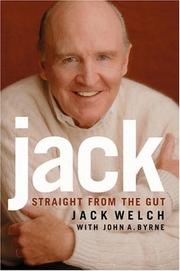
Jack: Straight from the Gut

Jack: Straight from the Gut

Jack Welch, John A. Byrne
2001
T2 480 pages · about 8h to read Open Librarygoodreads

Insider account: Welch's own version of the GE method.

Summary

Welch ran General Electric from 1981 to 2001 and wrote this memoir with John Byrne immediately after retiring. It covers his rise through the plastics business, the succession contest, and the twenty years during which GE's market value grew from around thirteen billion dollars to several hundred billion.

The management practices are stated directly. The number one or number two rule required every business to hold a leading position in its market or be fixed, closed or sold, and Welch divested or shut a large number of businesses in the early years, which produced the extensive layoffs behind his nickname. The vitality curve ranked employees into the top twenty percent, the middle seventy percent and the bottom ten percent, with the bottom removed annually. Work-Out sessions brought employees together to remove bureaucratic processes with managers required to decide on the spot. Six Sigma was adopted across the company as a quality programme. He pushed GE into services and into financial services through GE Capital, which became a substantial share of earnings.

His stated management philosophy centres on candour, on facing reality, on the removal of layers, and on the argument that leaders must have both results and values and that people with results and without values must be removed.

The book was written at the peak of Welch's reputation and before GE's decline. It says almost nothing about GE Capital's risk, about the earnings management that later analysis identified, or about the accounting practices that smoothed results across quarters. Gryta and Mann's Lights Out covers what followed. The forced ranking practice has been abandoned by most companies that adopted it.

Key takeaways 8

  1. Every business was required to hold a leading position in its market or be fixed, closed or sold, which drove extensive divestment and layoffs.
  2. Employees were ranked annually into three groups with the bottom ten percent removed, which Welch defends as the fairest available approach.
  3. Removing layers of management increases the speed of decisions and the accountability of the people who remain.
  4. Leaders must deliver both results and values, and people who deliver results while violating the values must be removed visibly.
  5. Bringing employees together to identify and remove bureaucratic processes, with managers required to decide immediately, was the Work-Out mechanism.
  6. Moving from products into services and financing changed GE's earnings profile substantially, with GE Capital becoming a major contributor.
  7. Candour and facing reality are stated as the two central management requirements, which Welch treats as unusual rather than as standard.
  8. The book predates GE's decline and says nothing about the risks in GE Capital or the earnings management that later analysis identified.

Who should read it

Executives who want the practices of the most celebrated manager of his period, read against the subsequent record of the company he built.

Who recommended it 3 · 1 direct

Similar books 6

Chosen by shared topics, the entries that hold them, and the people who recommended both.
Jeff Immelt, Amy Wallace · 2021

Insider account: Immelt's defence of his sixteen years as CEO.

David Gelles · 2022

Polemic treating Welch's GE as the template for shareholder primacy.
Noel M. Tichy, Stratford Sherman · 1993

The admiring contemporary account of Welch's restructuring.

Louis V. Gerstner · 2002

How IBM was kept whole in 1993 and turned from hardware toward services.

Recommended by: Mohnish Pabrai, Aaron Levie
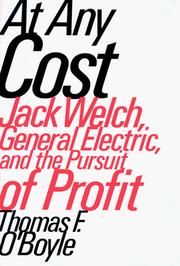
Thomas F. O'Boyle · 1998

The contemporaneous dissent, twenty years ahead of the consensus.

Where it sits in the reference 3

Companies
Business themes
Business themes

Topics

Biography and MemoirBusiness and ManagementLeadershipExecutives and Corporate Insiders