Updates

  1. Person pages list letters, writing, profiles and links as sortable tables with filters, and show each person's companies as links; Fund letters show each letter's description in its own column.
  2. Experts show a checked job title and a short description of each person; 30 more people have photographs.
  3. Every company, fund, university and publication the experts work for has a page listing the people there.
  4. Fund letters show each letter's thesis and filter by it; 225 person pages list the essays, columns and newsletter issues the person wrote.
  5. Person pages list every essay and newsletter issue a person wrote, and their own books as a table in List view.
  6. Recommends shows the five largest kinds of book and the rest under More; browse pictures load sooner.
  7. Podcasts and talks link the original episode, filter by Audio and video or Press, and list each publisher once.
  8. Pages are wider, Recommends has List and Grid, and a filter clicked again turns off.
  9. Book cards sit in a ruled grid with Open Library and Goodreads links and each book's one-line note.
  10. Funds is now Investors; each investor's styles are buttons that filter the table.
  11. Podcasts and talks on a person's page filter by year and publisher and show as a list or a grid of pictures.
  12. Quotes show only people's own words: 472 summaries written by list sites are gone.
  13. Country pages open from Browse again, and every link on the shelf lands on a page.
  14. Subject and person pages show their sections as tabs, and each book appears once on a person's page.
  15. Book cards show the quote, who said it and the source; grids show five cards to a row.
  16. On a phone, a menu holds the sections, search, Updates, Feedback and dark mode.
  17. Feedback takes a screenshot of the page with no browser prompt, opens a screenshot full size when you click it, and clears itself once sent.
  18. Book cards are centred, search names the topic each book sits in, and any text cut short shows whole on hover.
  19. Search groups its results by kind: people, companies, geographies, subjects, topics, books, funds, fund letters and papers.
  20. The Books table lists who recommended each book by name, and the browser tab names the section you are in.
  21. Feedback can take a screenshot of the page, or one you paste or choose, and opens in the corner beside Updates.
  22. Each rail button reopens its section where you left it, and Browse, Table and People show on every book and subject page.
  23. Filters grey out choices that hold nothing instead of hiding them, and Books › People filters by authors or recommenders.
  24. Feedback takes a subject line and up to three screenshots.
  25. Biographies are grouped by the person they are about: 41 new pages, from Abraham Lincoln to Lee Kuan Yew.
  26. Sport splits into 23 sports, and Religion into one topic per faith.
  27. Book lists show as cards: the cover, one recommendation quote and every recommender by name.
  28. Seventeen subjects that had two or three pages under different names now have one page each.
  29. Every page lists its Experts as authors and recommenders, with a link to them on the Experts tab.
  30. Economics, Financial history, Financial panics and Accounting are subjects of their own, with one page per financial crisis.
  31. Book, person and subject pages open inside the app, so the tabs stay in view.
  32. 996 more book covers, and photographs or logos for 227 more people and companies.
  33. Books › Browse shows every subject as cards, and the rail holds Fund letters, Papers, Experts, Books and Funds.
  34. Every topic over 150 books splits into narrower topics, each with a page of its own.

Send feedback

What is it?
Screenshots, up to 3 (optional)
or paste one with Ctrl+V

We use your email only to reply to you.

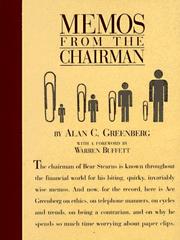
Memos from the Chairman

Memos from the Chairman

Alan C. Greenberg
1996
T3 158 pages · about 2h 38m to read Open Librarygoodreads

Greenberg's own memos; the cost culture Bear ran on before it broke.

Summary

This is a collection of the internal memos Alan Greenberg wrote to Bear Stearns employees while he was chairman, from 1978 through the mid-1990s. They are short, most under a page, and they were circulated to everyone in the firm.

The recurring subjects are cost control, hiring and personal conduct. Greenberg pushed relentlessly on expenses, including a famous instruction about reusing paper clips and rubber bands, and the point was not the money saved but the signal that no expense was beneath examination. He instructed that employees should hire people with what he called PSD degrees, meaning poor, smart and a deep desire to become rich, and he was explicit that credentials were not what he wanted. He required that all bad news reach him immediately and made clear that concealing a problem was the one unforgivable act. He set a rule that every senior employee must give four percent of pre-tax income to charity, and enforced it.

Many of the memos quote a fictional sage, Haimchinkel Malintz Anaynikal, whom Greenberg invented so that he could deliver instruction as maxim rather than as order. The book takes an hour to read and functions as a short course in how a firm's culture is transmitted by repeated specific written communication rather than by values statements. The obvious complication is that Bear Stearns failed in 2008, a decade after these memos, and readers should think about which of Greenberg's practices survived his tenure and which did not. The collection has no analysis and no context beyond brief introductions.

Key takeaways 7

  1. Cost control should be applied to trivial expenses precisely because the amount saved is small, since the point is to establish that nothing is exempt from scrutiny.
  2. Hiring should favour people with strong motivation and no advantages over people with elite credentials, because the first group works harder and stays.
  3. Bad news must reach the top immediately, and concealing a problem should be the one offence that ends a career.
  4. Repeated short written communication from the top, on specific concrete matters, transmits culture more effectively than any formal statement of values.
  5. Selling a losing position quickly is a rule to be enforced institutionally, because individuals will not do it reliably on their own judgement.
  6. Requiring senior staff to give a fixed percentage of income to charity is enforceable and changes behaviour, where encouragement does not.
  7. Complacency after good results is the specific risk a profitable firm faces, and it must be attacked while results are good.

Who should read it

Managers and founders interested in how culture is transmitted through repeated specific communication, in a very short primary-source collection.

Who recommended it 2 · 1 direct

Similar books 6

Chosen by shared topics, the entries that hold them, and the people who recommended both.

Bryce G. Hoffman · 2012

The 2006-2010 turnaround told with close management access.

Recommended by: Mohnish Pabrai
Jack Welch, John A. Byrne · 2001

Running General Electric from 1981 to 2001, as told on retiring.

Where it sits in the reference 3

Companies
Business themes
Business themes

Topics

Business and ManagementLeadership