Updates

  1. Person pages list letters, writing, profiles and links as sortable tables with filters, and show each person's companies as links; Fund letters show each letter's description in its own column.
  2. Experts show a checked job title and a short description of each person; 30 more people have photographs.
  3. Every company, fund, university and publication the experts work for has a page listing the people there.
  4. Fund letters show each letter's thesis and filter by it; 225 person pages list the essays, columns and newsletter issues the person wrote.
  5. Person pages list every essay and newsletter issue a person wrote, and their own books as a table in List view.
  6. Recommends shows the five largest kinds of book and the rest under More; browse pictures load sooner.
  7. Podcasts and talks link the original episode, filter by Audio and video or Press, and list each publisher once.
  8. Pages are wider, Recommends has List and Grid, and a filter clicked again turns off.
  9. Book cards sit in a ruled grid with Open Library and Goodreads links and each book's one-line note.
  10. Funds is now Investors; each investor's styles are buttons that filter the table.
  11. Podcasts and talks on a person's page filter by year and publisher and show as a list or a grid of pictures.
  12. Quotes show only people's own words: 472 summaries written by list sites are gone.
  13. Country pages open from Browse again, and every link on the shelf lands on a page.
  14. Subject and person pages show their sections as tabs, and each book appears once on a person's page.
  15. Book cards show the quote, who said it and the source; grids show five cards to a row.
  16. On a phone, a menu holds the sections, search, Updates, Feedback and dark mode.
  17. Feedback takes a screenshot of the page with no browser prompt, opens a screenshot full size when you click it, and clears itself once sent.
  18. Book cards are centred, search names the topic each book sits in, and any text cut short shows whole on hover.
  19. Search groups its results by kind: people, companies, geographies, subjects, topics, books, funds, fund letters and papers.
  20. The Books table lists who recommended each book by name, and the browser tab names the section you are in.
  21. Feedback can take a screenshot of the page, or one you paste or choose, and opens in the corner beside Updates.
  22. Each rail button reopens its section where you left it, and Browse, Table and People show on every book and subject page.
  23. Filters grey out choices that hold nothing instead of hiding them, and Books › People filters by authors or recommenders.
  24. Feedback takes a subject line and up to three screenshots.
  25. Biographies are grouped by the person they are about: 41 new pages, from Abraham Lincoln to Lee Kuan Yew.
  26. Sport splits into 23 sports, and Religion into one topic per faith.
  27. Book lists show as cards: the cover, one recommendation quote and every recommender by name.
  28. Seventeen subjects that had two or three pages under different names now have one page each.
  29. Every page lists its Experts as authors and recommenders, with a link to them on the Experts tab.
  30. Economics, Financial history, Financial panics and Accounting are subjects of their own, with one page per financial crisis.
  31. Book, person and subject pages open inside the app, so the tabs stay in view.
  32. 996 more book covers, and photographs or logos for 227 more people and companies.
  33. Books › Browse shows every subject as cards, and the rail holds Fund letters, Papers, Experts, Books and Funds.
  34. Every topic over 150 books splits into narrower topics, each with a page of its own.

Send feedback

What is it?
Screenshots, up to 3 (optional)
or paste one with Ctrl+V

We use your email only to reply to you.

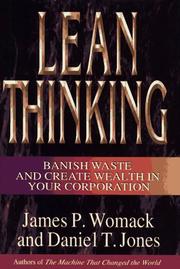
Lean Thinking

Lean Thinking

James P. Womack, Daniel T. Jones
1996
T1 396 pages · about 6h 36m to read Open Librarygoodreads

Value, flow and pull generalised beyond the car industry.

Summary

Womack and Jones generalise the Toyota Production System into five principles applicable beyond automotive manufacturing, following their earlier study The Machine That Changed the World.

The five principles are: specify value from the end customer's perspective, since value defined by the producer is usually the producer's convenience; identify the value stream, meaning every step from raw material to customer, and classify each step as creating value, creating no value but currently unavoidable, or creating no value and immediately removable; make value flow continuously by eliminating the batching, queuing and departmental handoffs that create waiting; let the customer pull value rather than producing to a forecast and pushing inventory downstream; and pursue perfection through repeated cycles, since each improvement reveals the next constraint.

Their empirical claim is that mapping a complete value stream in most organisations reveals that the large majority of elapsed time adds no value, with the actual work occupying a small fraction of the total. The case studies cover manufacturers in several countries including Pratt and Whitney, Porsche, Lantech and Wiremold, with before and after figures for inventory, lead time, space and productivity. The book also covers the organisational difficulty, including that value streams cross departmental boundaries and that departmental optimisation is what produces the waste.

The examples are manufacturing and the translation to service and knowledge work, which the authors attempted later, is harder than they present it. Lean has been widely implemented as a cost-cutting programme rather than as the system described, which the authors have criticised. The value stream mapping method is the tool practitioners use.

Key takeaways 8

  1. Value must be specified from the end customer's perspective, since value defined by the producer usually describes the producer's convenience.
  2. Mapping a complete value stream reveals that the large majority of elapsed time adds no value, with actual work occupying a small fraction.
  3. Every step in a process should be classified as creating value, creating none but currently unavoidable, or creating none and immediately removable.
  4. Batching, queuing and departmental handoffs create the waiting that constitutes most of the elapsed time.
  5. Production should be pulled by actual customer demand rather than pushed from a forecast, which removes the inventory that conceals problems.
  6. Value streams cross departmental boundaries, and optimising each department separately is what produces the waste.
  7. Each improvement reveals the next constraint, which means the process repeats rather than completing.
  8. Lean has been widely implemented as a cost-cutting programme rather than as the system described, which the authors have criticised.

Who should read it

Operators in manufacturing and in any process business who want the value stream mapping method and the five principles in their original form.

Who recommended it 2 · 1 direct

Similar books 6

Chosen by shared topics, the entries that hold them, and the people who recommended both.
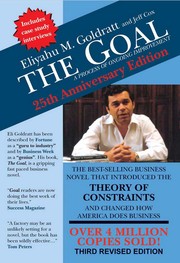
Eliyahu M. Goldratt, Jeff Cox · 1984

A plant manager learns that a system's output is set by its bottleneck.

Bob Fifer · 1994

Cost discipline handbook widely used by buyout and turnaround operators

Robert S. Kaplan, David P. Norton · 1996

Measure a firm on finance, customers, internal processes, and learning and growth.

Recommended by: Mohnish Pabrai

Eliyahu M. Goldratt · 2008

A dialogue on thinking clearly: reality is simple, conflicts can be resolved.

Recommended by: Mohnish Pabrai

Where it sits in the reference 2

Business themes
Business themes

Topics

Business and Management