Updates

  1. Person pages list letters, writing, profiles and links as sortable tables with filters, and show each person's companies as links; Fund letters show each letter's description in its own column.
  2. Experts show a checked job title and a short description of each person; 30 more people have photographs.
  3. Every company, fund, university and publication the experts work for has a page listing the people there.
  4. Fund letters show each letter's thesis and filter by it; 225 person pages list the essays, columns and newsletter issues the person wrote.
  5. Person pages list every essay and newsletter issue a person wrote, and their own books as a table in List view.
  6. Recommends shows the five largest kinds of book and the rest under More; browse pictures load sooner.
  7. Podcasts and talks link the original episode, filter by Audio and video or Press, and list each publisher once.
  8. Pages are wider, Recommends has List and Grid, and a filter clicked again turns off.
  9. Book cards sit in a ruled grid with Open Library and Goodreads links and each book's one-line note.
  10. Funds is now Investors; each investor's styles are buttons that filter the table.
  11. Podcasts and talks on a person's page filter by year and publisher and show as a list or a grid of pictures.
  12. Quotes show only people's own words: 472 summaries written by list sites are gone.
  13. Country pages open from Browse again, and every link on the shelf lands on a page.
  14. Subject and person pages show their sections as tabs, and each book appears once on a person's page.
  15. Book cards show the quote, who said it and the source; grids show five cards to a row.
  16. On a phone, a menu holds the sections, search, Updates, Feedback and dark mode.
  17. Feedback takes a screenshot of the page with no browser prompt, opens a screenshot full size when you click it, and clears itself once sent.
  18. Book cards are centred, search names the topic each book sits in, and any text cut short shows whole on hover.
  19. Search groups its results by kind: people, companies, geographies, subjects, topics, books, funds, fund letters and papers.
  20. The Books table lists who recommended each book by name, and the browser tab names the section you are in.
  21. Feedback can take a screenshot of the page, or one you paste or choose, and opens in the corner beside Updates.
  22. Each rail button reopens its section where you left it, and Browse, Table and People show on every book and subject page.
  23. Filters grey out choices that hold nothing instead of hiding them, and Books › People filters by authors or recommenders.
  24. Feedback takes a subject line and up to three screenshots.
  25. Biographies are grouped by the person they are about: 41 new pages, from Abraham Lincoln to Lee Kuan Yew.
  26. Sport splits into 23 sports, and Religion into one topic per faith.
  27. Book lists show as cards: the cover, one recommendation quote and every recommender by name.
  28. Seventeen subjects that had two or three pages under different names now have one page each.
  29. Every page lists its Experts as authors and recommenders, with a link to them on the Experts tab.
  30. Economics, Financial history, Financial panics and Accounting are subjects of their own, with one page per financial crisis.
  31. Book, person and subject pages open inside the app, so the tabs stay in view.
  32. 996 more book covers, and photographs or logos for 227 more people and companies.
  33. Books › Browse shows every subject as cards, and the rail holds Fund letters, Papers, Experts, Books and Funds.
  34. Every topic over 150 books splits into narrower topics, each with a page of its own.

Send feedback

What is it?
Screenshots, up to 3 (optional)
or paste one with Ctrl+V

We use your email only to reply to you.

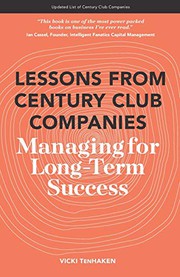
Lessons from Century Club Companies

Lessons from Century Club Companies

Vicki TenHaken
2016
T4 160 pages · about 2h 40m to read Open Librarygoodreads

What firms surviving a hundred years have in common

Summary

TenHaken, a management professor who had worked at Herman Miller, studied Japanese companies that had operated for more than one hundred years, of which Japan has an unusually large number, and identified what they had in common.

Her research covered surveys and interviews with long-surviving Japanese firms, most of them small and medium-sized rather than the large corporations that receive attention. The practices she reports include: maintaining relationships with employees, suppliers, customers and the local community over generations rather than transactionally; conservative financial management with low debt and substantial reserves held specifically to survive downturns without laying off staff; a stated corporate philosophy that predates the current management and constrains what the company will do; slow deliberate expansion within a defined competence rather than diversification; deliberate succession planning conducted over years, including the Japanese practice of adopting a capable successor into the family where no suitable heir exists; and treating the business as something held in trust for the next generation rather than owned outright by the current one.

She contrasts this with the American pattern of maximising current returns and treating relationships as transactions to be repriced.

The research is survey-based and the sample is selected on survival, so the practices identified are correlates rather than demonstrated causes. Japanese institutional conditions including bank relationships, employment norms and family structures differ enough that transferability is a real question, which TenHaken addresses briefly. The reference has not verified the specific research findings.

Key takeaways 7

  1. Japan contains an unusually large number of companies over one hundred years old, most of them small and medium-sized rather than large corporations.
  2. Long-surviving firms hold substantial financial reserves specifically to survive downturns without breaking employment relationships.
  3. Relationships with employees, suppliers and customers are maintained across generations rather than repriced transactionally at each opportunity.
  4. A stated corporate philosophy predating the current management constrains what the company will do and survives leadership changes.
  5. Expansion is slow and stays within a defined competence, which limits growth and removes the failure mode of diversification into unfamiliar businesses.
  6. Succession is planned over years, and the Japanese practice of adopting a capable successor into the family removes the constraint of biological inheritance.
  7. The sample is selected on survival, so the practices identified are correlates rather than demonstrated causes of longevity.

Who should read it

Owners of family and closely held businesses interested in longevity practices and succession, with the transferability question left open.

Who recommended it 1 · 1 direct

“''Lessons from Century Club Companies, Managing for Long Term Success'' by Vicki Tenhaken”

Similar books 6

Chosen by shared topics, the entries that hold them, and the people who recommended both.

Bryce G. Hoffman · 2012

The 2006-2010 turnaround told with close management access.

Recommended by: Mohnish Pabrai

Dieter Brandes · 2004

Aldi's hard-discount method: radical simplicity as the way to keep costs low.

Where it sits in the reference 3

Business models
Business themes
Business themes

Topics

Business and ManagementCompany Histories