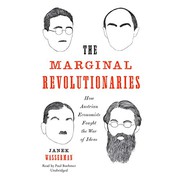
Marginal Revolutionaries: How Austrian Economists Fought the War of Ideas
The Austrian School of economics, from Viennese coffeehouses to the Tea Party.
History of the Vienna school as a network, including its financing and its export to the US.
Summary
Janek Wasserman, a historian, writes the Austrian School as a social and institutional history rather than as a sequence of ideas. His subject is how a group of Viennese economists became first an academic school, then an emigre network, and finally the intellectual foundation of an American libertarian movement.
The narrative runs from Carl Menger and the marginalist arguments of the 1870s, through Bohm-Bawerk and Wieser and the school's position within the Habsburg bureaucracy, to the interwar Vienna of Mises's private seminar and the wider circles that included Hayek, Machlup, Morgenstern, Haberler and Schumpeter. Wasserman emphasises the institutional supports: the Chamber of Commerce, the business associations, the Rockefeller Foundation funding, and the personal networks that placed Austrians in American and British universities after emigration. He then traces the postwar transformation, in which the school's academic position in economics departments declined while its political influence grew through the Mont Pelerin Society, the Volker Fund, and business-funded institutes.
Wasserman's argument is that the Austrian School was always a political project as much as a scientific one, and that its self-presentation as disinterested science obscures the funding and the institutional interests behind it. Readers sympathetic to Austrian economics will find this reductive, and the book does give less attention to the substance of the economic arguments than to their sponsorship. The archival research on funding and networks is the contribution.
Key takeaways 7
- The Austrian School was sustained by business and chamber-of-commerce funding from its early decades, not only in its American phase.
- Menger's marginalism was mainstream economics in its period, and the school's separation from the mainstream came later and for political reasons.
- Mises's private seminar in Vienna produced a network whose members carried the school into American and British universities after 1938.
- Hayek's postwar prominence rested on organisational work through the Mont Pelerin Society as much as on his economic writing.
- The school lost standing in academic economics during the same period that its political influence grew, and Wasserman treats these as connected.
- American libertarian institutions funded and reshaped Austrian economics into a doctrine considerably more absolutist than its Viennese founders held.
- Wasserman argues that presenting the school as a persecuted scientific minority conceals the institutional resources it commanded.
Who should read it
Readers who want the institutional and funding history behind a school of economics whose ideas circulate widely in investing and policy circles.
Similar books 6
Chosen by shared topics, the entries that hold them, and the people who recommended both.
A history of economic theory and the economists who built it.
Recommended by: Eric Weinstein
An early argument on building, the construction trade, taxes and population.
Recommended by: Marc Andreessen
Why population growth always presses against the food supply.
Recommended by: Mohnish Pabrai
How modern economics came to be, through the people who made it.
Recommended by: Mohnish Pabrai

How economics copied the maths of 19th-century physics, and what that cost it.
“Mirowski, Philip, More Heat than Light: Economics as Social Physics, Physics as Nature’s Economics (Cambridge: Cambridge University Press, 1989)” — Michael Mauboussin
Source: Size Matters: The Kelly Criterion and the Importance of Money Management, page 12
Recommended by: Michael Mauboussin, Eric Weinstein
How the Industrial Revolution's self-regulating market upended society.
Recommended by: Satya Nadella