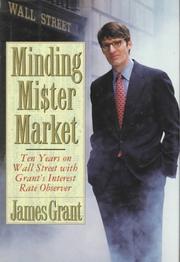
Minding Mr. Market: Ten Years on Wall Street with Grant's Interest Rate Observer
A decade of pieces from a newsletter on interest rates and credit markets.
title listed on grantspub.com books page
Summary
Grant collected pieces from the first decade of Grant's Interest Rate Observer, the newsletter he founded in 1983 after leaving Barron's, covering the period from the start of the great bond bull market through the early 1990s.
The recurring analytical positions are the value of the collection. Grant writes from a credit perspective, arguing that the price of money determines everything else and that the market's willingness to lend is a better indicator of where a cycle stands than any measure of enthusiasm for equities. He is consistently sceptical of leverage, of financial innovation that claims to reduce risk, and of the assumption that a lender's models describe the borrower's actual condition. He covers the savings and loan crisis, the leveraged buyout boom and its collapse, the commercial real estate cycle, the junk bond market's rise and failure, and the Japanese asset bubble.
The format lets a reader see positions taken in real time with the outcome known, which is the main use. Grant was early on several correct calls and wrong on others, particularly on inflation and on the duration of the bond bull market, and the collection includes both.
Grant's prose style is distinctive, dense with irony and historical allusion, and readers either enjoy it or do not. The specific market situations are thirty years old. What transfers is the credit-first analytical posture and the demonstration that being correct about a cycle's excesses does not tell you when it ends.
Key takeaways 7
- The price and availability of credit determines asset prices, so the lending market indicates where a cycle stands better than equity market sentiment does.
- A lender's risk models describe the lender's assumptions rather than the borrower's condition, and the two diverge most at cycle peaks.
- Financial innovations that claim to reduce risk generally relocate it to a place where it is not being measured.
- Being correct about a cycle's excesses tells you nothing about when it will end, and the holding cost of being early can exceed the eventual gain.
- Credit standards deteriorate gradually and invisibly during an expansion because each individual relaxation is defensible on its own.
- Interest rates are the price of time and their level shapes every other valuation, which makes rate analysis prior to security analysis.
- Reading contemporaneous commentary with the outcome known is the best available calibration on one's own real-time judgement.
Who should read it
Investors who want a credit-first analytical posture demonstrated across a decade of real-time positions with the outcomes known.
About James Grant
Founder and editor, Grant's Interest Rate Observer (since 1983); financial historian and biographer
Grant's Interest Rate Observer is a primary source other investors read and quote, and Money of the Mind is a standard credit history.
Who recommended it 3 · 2 direct
“To give you a small taste of how devastating his prose can be, consider his treatment of the efficient matket hypothesis in the Introduction of his book, Minding Mr. Market: To suppose that the value of a common stock is determined by a corporation's earnings discounted by the relevant interest rate and adjusted for the marginal tax rate is to forget that people have burned witches, gone to war on a whim, risen to the defense …”
Similar books 6
Chosen by shared topics, the entries that hold them, and the people who recommended both.
A decade of essays on the technology bubble, its collapse and the credit boom after.
Recommended by: Mohnish Pabrai, Seth Klarman
Bernard Baruch, from speculator to adviser of presidents and public figure.
Recommended by: Seth Klarman
Stock, bond and bill returns for sixteen countries from 1900 to 2000.
“Recently Dimson, Marsh, and Staunton, in their wonderful monograph, The Triumph of the Optimists, have examined the real dividend-growth rates in 16 nations over the entire 20th century.” — William J. Bernstein
Source: Efficient Frontier, issue 702 (2002)
Recommended by: Jason Zweig, Mohnish Pabrai and 1 other
Recommended by: Mohnish Pabrai
How Capital Group built its long-term investing culture.
“A fine new book (Capital, with the foregoing words in its subtitle) by respected analyst Charles D. Ellis drives this point home.” — John C. Bogle
Source: As The Index Fund Moves From Heresy to Dogma… What More Do We Need To Know, page 10
Recommended by: John C. Bogle, Mohnish Pabrai
Profiles of people who succeeded in different kinds of investing.
Recommended by: Mohnish Pabrai