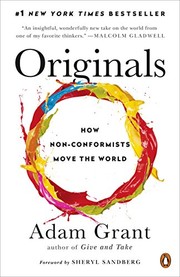
Originals: How Non-Conformists Move the World
How people champion new ideas, and how leaders can encourage originality.
Summary
The reference has not verified this book in detail; the summary states only what the title, author and subject establish.
Grant, author of Give and Take, examines how people can champion new ideas that go against the grain and how leaders can encourage originality in organisations. Using studies and stories from business, politics, sport and entertainment, he covers how to recognise a good idea, speak up without being silenced, build a coalition of allies, choose the right time to act, and manage fear and doubt.
The book also addresses how parents and teachers can nurture originality in children and how leaders can fight groupthink and build cultures that welcome dissent. Its cases include an entrepreneur who pitches his start-ups by listing the reasons not to invest, a woman at Apple who challenged Steve Jobs from three levels below him, an analyst who overturned the rule of secrecy at the CIA, a billionaire investor who fires employees for failing to criticise him, and a television executive outside comedy who saved Seinfeld from cancellation. Grant's aim is a set of practical lessons on rejecting conformity and improving the status quo without risking everything.
Key takeaways 4
- Original ideas succeed more often when their champions manage risk rather than gamble everything.
- Choosing the right time to act is part of getting an original idea adopted.
- Building a coalition of allies helps a dissenter avoid being silenced.
- Leaders who reward criticism and dissent guard their organisations against groupthink.
Who should read it
Managers and founders who want research-based advice on proposing unpopular ideas and on running teams that tolerate dissent.
About Adam Grant
Organisational psychologist and professor of management at the Wharton School, University of Pennsylvania.
Give and Take presents evidence that people who default to helping others cluster at both the bottom and the top of performance distributions, and identifies what separates the two groups - directly useful for anyone designing incentives or picking partners. Think Again and Originals cover how people revise beliefs against new evidence and how unfamiliar ideas get championed inside established organisations.
Who recommended it 11 · 4 direct
Similar books 6
Chosen by shared topics, the entries that hold them, and the people who recommended both.
Why innovation comes where fields, industries and cultures meet.
Recommended by: Mohnish Pabrai
What sets apart serial innovators, from the lives of eight of them.
Recommended by: Keith Rabois
Why startups should build something new and own a small market before growing.
“Inspired by modern tech classics like Zero to One and The Hard Thing About Hard Things, I wrote the book to be succinct, thorough, and accessible.” — Chris Dixon
Source: I wrote a book: Read Write Own — cdixon
Recommended by: Balaji S. Srinivasan, Chris Dixon and 38 others
Why well-run firms lose to cheaper, worse products that enter at the market's bottom.
“Clayton Christensen's big "aha" in Innovator's Dilemma is that eventually a product will become over-featured and as a result feature growth will slow, and along with it innovation.” — Bill Gurley
Source: Picture Proof of the Innovator’s Dilemma: SlideRocket
Recommended by: Bill Gurley, Drew Houston, Jim Collins and 29 others
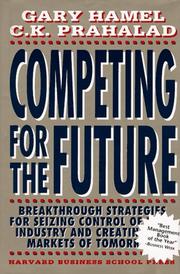
How firms lead future industries by seeing tomorrow's chances and building skills.
Recommended by: Mohnish Pabrai
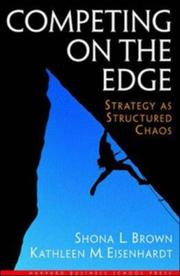
Strategy as constant reshaping of advantage in fast, unpredictable markets.
Recommended by: Mohnish Pabrai
Where it sits in the reference 2
Topics 3
As an Amazon Associate I earn from qualifying purchases.