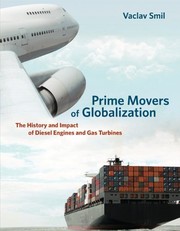
Prime Movers of Globalization
How the diesel engine and the gas turbine made modern global trade possible.
Summary
Smil argues that modern globalisation rests on two machines: the high-compression non-sparking internal combustion engine invented by Rudolf Diesel, and the gas turbine developed by Frank Whittle and Hans von Ohain. He gives each a full technical and economic history, from the invention through the engineering development to the current fleet.
The argument is quantitative. Diesel engines move essentially all ocean freight and most land freight, and their thermal efficiency, now above fifty percent for large marine engines, is what makes intercontinental shipping cost so little per tonne-kilometre that distance stopped mattering for production location. Gas turbines move people and high-value freight by air and generate a large share of electricity, and their power-to-weight ratio is what made mass air travel possible. Smil supplies the efficiency curves, the fleet numbers, the fuel consumption figures and the development timelines, and he shows that both technologies took decades from invention to commercial dominance.
The wider point he presses is about the pace of technological transition. Both prime movers required roughly fifty years from working prototype to widespread deployment, and both remain without practical substitutes at the scale they operate. Smil uses this to argue against expectations of rapid energy transitions. The book is technical, dense with engineering detail, and written for readers willing to follow specifications. It is not a business book and it makes no strategic recommendations. Its data ends around 2009, and the subsequent development of battery electric transport and of alternative marine fuels is a live test of his substitution scepticism.
Key takeaways 7
- Ocean and land freight run almost entirely on diesel engines, and their thermal efficiency is what reduced transport cost enough to make production location independent of distance.
- Gas turbines made mass air travel possible through power-to-weight ratios that no other engine achieves, and they also generate a large share of electricity.
- Both prime movers took roughly fifty years from working prototype to dominant deployment, which sets a base rate for how long fundamental energy technologies take to diffuse.
- Large marine diesel engines now exceed fifty percent thermal efficiency, which is higher than any other widely deployed heat engine.
- Neither prime mover has a practical substitute at the scale it currently operates, which constrains how quickly transport can be decarbonised.
- Globalisation is a physical achievement resting on specific machines, not primarily a political or financial development.
- Incremental engineering improvement over decades, not the original invention, produced most of the performance gain in both technologies.
Who should read it
Investors in transport, energy or industrials who want the physical and quantitative basis of freight economics and a base rate for technology diffusion.
About Vaclav Smil
Distinguished professor emeritus at the University of Manitoba; writes quantitative histories of energy, food, materials and technical change.
Each book counts the physical inputs an economy consumes - joules, tonnes of steel, ammonia, cement - and establishes the historical rates at which past energy transitions actually moved. Those numbers let an investor size decarbonisation timelines and test claims about how fast an energy system can be rebuilt.
Who recommended it 2 · 2 direct
Similar books 6
Chosen by shared topics, the entries that hold them, and the people who recommended both.
How American manufacturing rose to lead the world, and why its share then fell.
Recommended by: Mohnish Pabrai, Bill Gates
How much steel, cement and plastic the world uses, and whether growth needs less.
Recommended by: Bill Gates, Mohnish Pabrai, Mark Zuckerberg

How inventions of 1867 to 1914, from electricity to cars, made the modern world.
“My favorite Smil book, Creating the Twentieth Century (and its companion, Transforming the Twentieth Century) chronicles the inventions of the last 150 years.” — Bill Gates
Source: Vaclav Smil on how energy makes life possible — Gates Notes
Recommended by: Bill Gates, Mohnish Pabrai, Li Lu
How the shipping container cut freight costs and remade global trade.
“History of the shipping container, and how it affected the world economy. Also for ambitious entrepreneurs, Malcom McLean is a damn good role model. Great read.” — Derek Sivers
Source: Derek Sivers book notes (primary, rated list) · Rating: 6/10
Recommended by: Bill Gates, Derek Sivers, Mohnish Pabrai and 2 others
Ten forces around 2000 that let anyone, anywhere compete in the global economy.
Recommended by: Jim Collins, Mohnish Pabrai, Bill Gates and 3 others
Long-distance trade from Mesopotamia and the spice routes to modern globalisation.
Recommended by: Patrick Collison, Mohnish Pabrai, Nick Szabo
Where it sits in the reference 2
Topics 3
As an Amazon Associate I earn from qualifying purchases.