Public Choice Theory and the Illusion of Grand Strategy
Why public choice theory explains American foreign policy better than grand strategy.
Summary
Richard Hanania argues that American foreign policy is better explained by public choice theory than by any theory of grand strategy. The president makes foreign policy decisions largely in response to political pressure, but concentrated interests shape the incentives under which he and other senior officials act. Hanania names three groups most likely to hold sway: government contractors, the national security bureaucracy and foreign governments.
He applies the public choice view to the most important parts of US foreign policy, including the war on terror, policy toward China and the placing of American forces abroad. Because American leaders are chosen to respond to public opinion rather than for their ability to form and carry out long-term plans, he argues, and because the public's views on foreign affairs are easily moved, there is little room for grand strategy. Those views are malleable because of ignorance of the subject, the secrecy around national security, the complexity of the issues and, above all, the pressure of concentrated interests.
Key takeaways 4
- Concentrated interests, not grand strategy, drive American foreign policy.
- Contractors, the security bureaucracy and foreign governments hold the most sway.
- Public opinion on foreign affairs is easily shaped because few voters know the subject.
- Secrecy and complexity weaken democratic control of national security.
Who should read it
Students of foreign policy who want a public choice critique of grand strategy.
Who recommended it 1 · 1 direct
Similar books 6
Chosen by shared topics, the entries that hold them, and the people who recommended both.
Economic freedom as a condition of political freedom, applied to policy questions.
“During the quarter, I reread three volumes authored by great economists: The General Theory of Employment, Interest and Money by John Maynard Keynes, The Road to Serfdom by F. A. Hayek, and Capitalism and Freedom by Milton Friedman.” — Martin J. Whitman
Source: Third Avenue Funds Q4 2005 Shareholder Letters (Chairman's letter by Martin J. Whitman)
Recommended by: Martin J. Whitman, Marc Andreessen
The case for free markets and limited government, policy area by policy area.
Recommended by: Brian Armstrong, Jim Collins, Mohnish Pabrai and 2 others
The case for globalisation and free trade against the anti-globalisation movement.
Recommended by: Marc Andreessen
How leaders of dictatorships and democracies gain and keep power.
Recommended by: Nat Eliason, Andrew Chen, Marc Andreessen
An inquiry into the nature of freedom and the uses of power.
Recommended by: Marc Andreessen
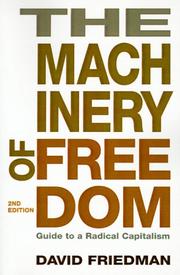
The case for anarcho-capitalism, a society run on markets without a state.
Recommended by: Marc Andreessen
Where it sits in the reference 1
Topics 3
As an Amazon Associate I earn from qualifying purchases.