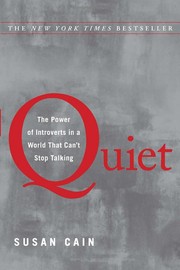
Quiet: The Power of Introverts in a World That Can't Stop Talking
How schools and workplaces built for extroverts waste what introverts offer.
Summary
Cain argues that Western institutions, particularly American schools and workplaces, are designed around what she calls the extrovert ideal, and that this wastes the contributions of the roughly one third to one half of people who are introverted. She traces the cultural shift historically, arguing that a nineteenth-century culture of character valuing inner virtue gave way in the early twentieth century to a culture of personality valuing charisma and self-presentation, driven by urbanisation, the rise of large corporations and the sales profession.
The research she draws on includes Jerome Kagan's longitudinal work on high-reactive infants, which found that temperament measured in infancy predicts adult introversion; Elaine Aron on sensory processing sensitivity; and Anders Ericsson's finding that deliberate practice is best done alone, which she uses against open offices and group work.
Her strongest practical arguments concern group work. She reviews the evidence that brainstorming in groups produces fewer and worse ideas than the same people working separately, that open-plan offices reduce productivity and increase stress, and that groups converge on the views of whoever speaks most rather than of whoever knows most. She also covers free trait theory, the argument that people can act out of character in service of goals they care about, and the cost of doing so continuously.
The personality science is contested, since introversion and extroversion are a continuum rather than types and the trait is only one of five in the standard model. Cain selects supportive research and the cultural history is broad. The material on group decision-making and on brainstorming is well supported and directly applicable.
Key takeaways 8
- Western institutions are designed around an extrovert ideal that treats assertiveness and social confidence as evidence of competence.
- Group brainstorming produces fewer and lower quality ideas than the same individuals working separately and pooling results.
- Groups converge on the views of whoever speaks most confidently rather than whoever has the best information.
- Temperament measured in infancy predicts adult introversion, which means the trait is substantially constitutional rather than learned.
- Open-plan offices reduce productivity and increase stress, and the evidence for their collaborative benefits is weak.
- Deliberate practice is most effective performed alone, which puts solitary work at the centre of skill development rather than at its margin.
- Introverted leaders outperform extroverted ones with proactive teams, because they listen and let initiative come from the team.
- People can act out of character in service of goals they care about, but sustained performance of a temperament they do not have carries a real cost.
Who should read it
Managers designing offices, meetings and hiring processes who want the evidence against group ideation and open plan working.
Who recommended it 10 · 4 direct
“Any introvert should like this book. Wonderful info and insights about introversion. It'll help you defend your preference for low-stimulus environments. Since reading it, I feel better about insisting on my quiet/alone time.”
“Cain, Susan, Quiet: The Power of Introverts in a World That Can’t Stop Talking (New York: Crown Publishers, 2012)”
Similar books 6
Chosen by shared topics, the entries that hold them, and the people who recommended both.
Why common sense misleads people when they try to explain how the world works.
“Tonight’s book was Everything Is Obvious* which was cleverly subtitled *Once You Know The Answer with a special bonus subtitle How Common Sense Fails Us by Duncan Watts. And yes – for those of you keeping track at home, I didn’t read a book last night; I was working on mine instead. I enjoyed this book.” — Brad Feld
Source: Book: Everything Is Obvious* — Feld Thoughts
Recommended by: Brad Feld, Derek Sivers, Michael Mauboussin and 1 other

Why people mistake luck for skill, above all in markets.
“Fooled By Randomness was unquestionably the best non-fiction book I read in 2005.” — Brad Feld
Source: Book Review: Fooled By Randomness — Feld Thoughts
Recommended by: Barton Biggs, Brad Feld, Derek Sivers and 15 others
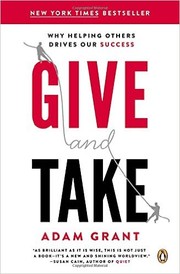
Givers, takers and matchers, and why givers end up both at the bottom and the top.
“If you feel you are too generous, or too greedy, or are wary and insist on reciprocation, consider reading this research-based look at the subject of these different personality types. Counter-intuitive findings.” — Derek Sivers
Source: Derek Sivers book notes (primary, rated list) · Rating: 6/10
Recommended by: Derek Sivers, Mohnish Pabrai, Alex Lieberman and 4 others
How talent is grown, not born, through a brain mechanism training can tap.
“A great book showing that deep practice - (struggling in certain targeted ways - operating at the edges of your ability, where you make mistakes - experiences where you're forced to slow down, make errors, and correct them) - is what really makes you improve at anything.” — Derek Sivers
Source: Derek Sivers book notes (primary, rated list) · Rating: 8/10
Recommended by: Derek Sivers, Michael Mauboussin and 5 others

Why IQ scores have risen from one generation to the next, the Flynn effect.
Recommended by: Mohnish Pabrai
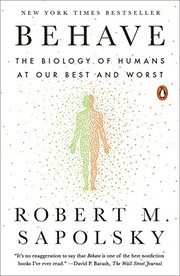
Explains an action by tracing its causes back from neurons to hormones to evolution.
“…books I've recommended, highlighted to death, or forced on friends.” — Andrew Wilkinson
Source: Andrew Wilkinson's Bookshelf, neverenough.com
Recommended by: Andrew Wilkinson, Vinod Khosla, Bill Gates and 5 others
Where it sits in the reference 2
As an Amazon Associate I earn from qualifying purchases.