Updates

  1. Person pages list letters, writing, profiles and links as sortable tables with filters, and show each person's companies as links; Fund letters show each letter's description in its own column.
  2. Experts show a checked job title and a short description of each person; 30 more people have photographs.
  3. Every company, fund, university and publication the experts work for has a page listing the people there.
  4. Fund letters show each letter's thesis and filter by it; 225 person pages list the essays, columns and newsletter issues the person wrote.
  5. Person pages list every essay and newsletter issue a person wrote, and their own books as a table in List view.
  6. Recommends shows the five largest kinds of book and the rest under More; browse pictures load sooner.
  7. Podcasts and talks link the original episode, filter by Audio and video or Press, and list each publisher once.
  8. Pages are wider, Recommends has List and Grid, and a filter clicked again turns off.
  9. Book cards sit in a ruled grid with Open Library and Goodreads links and each book's one-line note.
  10. Funds is now Investors; each investor's styles are buttons that filter the table.
  11. Podcasts and talks on a person's page filter by year and publisher and show as a list or a grid of pictures.
  12. Quotes show only people's own words: 472 summaries written by list sites are gone.
  13. Country pages open from Browse again, and every link on the shelf lands on a page.
  14. Subject and person pages show their sections as tabs, and each book appears once on a person's page.
  15. Book cards show the quote, who said it and the source; grids show five cards to a row.
  16. On a phone, a menu holds the sections, search, Updates, Feedback and dark mode.
  17. Feedback takes a screenshot of the page with no browser prompt, opens a screenshot full size when you click it, and clears itself once sent.
  18. Book cards are centred, search names the topic each book sits in, and any text cut short shows whole on hover.
  19. Search groups its results by kind: people, companies, geographies, subjects, topics, books, funds, fund letters and papers.
  20. The Books table lists who recommended each book by name, and the browser tab names the section you are in.
  21. Feedback can take a screenshot of the page, or one you paste or choose, and opens in the corner beside Updates.
  22. Each rail button reopens its section where you left it, and Browse, Table and People show on every book and subject page.
  23. Filters grey out choices that hold nothing instead of hiding them, and Books › People filters by authors or recommenders.
  24. Feedback takes a subject line and up to three screenshots.
  25. Biographies are grouped by the person they are about: 41 new pages, from Abraham Lincoln to Lee Kuan Yew.
  26. Sport splits into 23 sports, and Religion into one topic per faith.
  27. Book lists show as cards: the cover, one recommendation quote and every recommender by name.
  28. Seventeen subjects that had two or three pages under different names now have one page each.
  29. Every page lists its Experts as authors and recommenders, with a link to them on the Experts tab.
  30. Economics, Financial history, Financial panics and Accounting are subjects of their own, with one page per financial crisis.
  31. Book, person and subject pages open inside the app, so the tabs stay in view.
  32. 996 more book covers, and photographs or logos for 227 more people and companies.
  33. Books › Browse shows every subject as cards, and the rail holds Fund letters, Papers, Experts, Books and Funds.
  34. Every topic over 150 books splits into narrower topics, each with a page of its own.

Send feedback

What is it?
Screenshots, up to 3 (optional)
or paste one with Ctrl+V

We use your email only to reply to you.

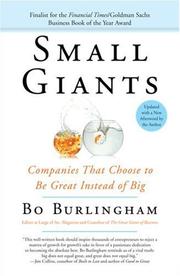
Small Giants

Small Giants

Bo Burlingham
2005
T2 268 pages · about 4h 28m to read Open Librarygoodreads

Firms that deliberately chose to be great rather than big.

Summary

Burlingham, an Inc magazine editor, profiles fourteen companies that chose to remain relatively small and privately held rather than pursue maximum growth, and identifies what they had in common. The companies include Anchor Brewing, Zingerman's, Clif Bar, Righteous Babe Records, O. C. Tanner and ECCO.

His central finding is that these companies made an explicit choice to prioritise something other than growth, usually quality of product, quality of working life, relationship with a community, or the owner's control over how the business operates. He calls the resulting quality mojo, and argues that it depends on the owners having consciously rejected the growth default rather than having failed to achieve it.

The common characteristics he identifies include founders who refused acquisition offers and outside capital, deliberate limits on customer acquisition and on geographic expansion, unusually deep relationships with a specific community or location, close attention to the working conditions of employees, and ownership structures designed to prevent forced sale. He covers the financial requirement directly, noting that all of these companies are profitable and that the model requires it, since a business without profit has no alternative to raising capital.

The sample is selected on outcome and Burlingham does not examine companies that made the same choices and failed. The businesses are mostly consumer, craft or service operations where scale provides limited advantage, and the model does not transfer to markets with network effects or capital intensity. The demonstration that the growth default is a choice rather than a requirement is the book's contribution.

Key takeaways 8

  1. Growth is a choice rather than a requirement, and these companies made an explicit decision to prioritise something else.
  2. Profitability is the precondition for staying small, since a business without profit has no alternative to raising outside capital.
  3. Refusing outside capital preserves the owner's ability to make decisions that a financial investor would reject.
  4. Deliberate limits on customer acquisition and geographic expansion allowed these companies to maintain the quality that distinguished them.
  5. Deep relationships with a specific community or location provided a defensible position that a larger competitor could not replicate.
  6. Ownership structures were designed explicitly to prevent forced sale, including arrangements that survive the founder.
  7. Employees in these companies received unusual attention to working conditions, which the owners treated as the point rather than as a cost.
  8. The sample consists of businesses where scale provides limited advantage, and the model does not transfer to capital-intensive or network markets.

Who should read it

Owners of profitable private businesses deciding whether to pursue growth or to optimise for control and quality.

Who recommended it 4 · 1 direct

Noah Kaganreported
Tom Petersreported

Similar books 6

Chosen by shared topics, the entries that hold them, and the people who recommended both.

Alan Weiss · 1992

Value pricing for solo and boutique consultancies.

Recommended by: Nat Eliason, Noah Kagan

David Heinemeier Hansson · 2010
Paul Jarvis · 2019

Why a business can stay small on purpose instead of chasing growth.

Where it sits in the reference 3

Business models
Business themes
Business themes

Topics

Entrepreneurship and StartupsBusiness and ManagementSmall Business and Bootstrapping