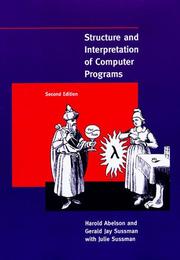
Structure and Interpretation of Computer Programs
MIT's introductory computer science text, taught through Lisp and Scheme.
The classic computer science text on abstraction and program structure
Summary
Abelson and Sussman, MIT professors writing with Julie Sussman, teach the fundamental principles of programming: recursion, abstraction, modularity, and the design and implementation of programming languages. The book looks for general patterns for solving specific problems and for building software systems from those patterns. It works in Scheme, a dialect of Lisp, and ends by using a simulated register machine and assembler to implement Lisp interpreters and compilers, so the reader builds the tools that run their own programs.
MIT Press published the first edition in 1984 and the second in 1996, and the book was the text for MIT's introductory course 6.001 from 1984 to 2007. Its chapters move from building abstractions with procedures, to building abstractions with data, to modularity, objects and state, to metalinguistic abstraction, and finally to computing with register machines. Philip Wadler criticised Scheme as a first language for its lack of pattern matching and algebraic data types and its strict evaluation, and How to Design Programs was written partly to answer those weaknesses. A JavaScript edition appeared in 2022.
Key takeaways 4
- Programs are built by layering abstractions, first over procedures and then over data.
- Introducing state and objects makes programs modular but makes reasoning about them harder.
- Writing an interpreter for a language is the most direct way to understand how that language works.
- Choosing an introductory language involves trade-offs, and Scheme's minimal syntax costs features such as pattern matching.
Who should read it
Programmers who want to understand abstraction and how languages are implemented, rather than learn a particular language or framework.
Who recommended it 4 · 3 direct
Similar books 6
Chosen by shared topics, the entries that hold them, and the people who recommended both.
A multi-volume monograph on programming algorithms and their analysis.
Recommended by: Patrick Collison, Marc Andreessen and 1 other
Computing taught as an extension of arithmetic, with programs as recursive functions.
“One of the most unique and effective pedagogic books ever written.” — Bret Victor
Source: Links — Bret Victor (his five-star list)
Recommended by: Bret Victor, Paul Graham, Susan J. Fowler
Lessons from IBM's OS/360: why adding people to a late software project slows it.
“Arguably the only classic book in our field. If you haven't read it, shame on you.” — Jeff Atwood
Source: Recommended Reading for Developers — Coding Horror
Recommended by: Jeff Atwood, Mohnish Pabrai, Paul Graham and 4 others
Software's enemy is complexity, which grows through shallow modules and shortcuts.
“Programming wisdom: modular design, keep APIs simple, how to avoid complexity, etc. Great insights from experience.” — Derek Sivers
Source: Derek Sivers book notes (primary, rated list) · Rating: 8/10
Recommended by: Derek Sivers
Advanced work on type systems and how they capture programs' run-time behaviour.
Recommended by: Patrick Collison
A reference on cryptography for programmers, with code in C.
Recommended by: Patrick Collison