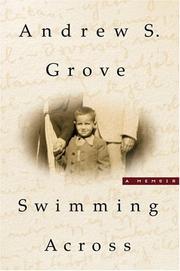
Swimming Across
A Jewish boy survives the war and Soviet rule in Hungary and escapes to America.
Insider: Grove's memoir of Hungary and escape, ending before Intel.
Summary
Grove wrote this memoir of his first twenty years, from his birth in Budapest in 1936 to his arrival in the United States in 1957. It ends before Intel and before anything he is known for, which is deliberate.
The narrative covers his childhood as a Jewish child in Hungary during the war, his survival with his mother under false identity while his father was taken to a labour battalion, the scarlet fever that damaged his hearing permanently, the postwar Communist period including the effect of his family's classification on his education and prospects, the 1956 uprising, and his escape across the Austrian border at twenty and his arrival in New York speaking almost no English.
The book contains no business content and no attempt to draw lessons. Grove states the events and what he understood at the time, and does not connect them to his later career. What the reader takes from it must be extracted. The recurring situation is one in which the rules changed without warning, in which the categories a person belonged to determined what was possible regardless of their conduct, and in which survival depended on reading the situation accurately and moving before the alternatives closed.
The title comes from an anecdote about a friend of his father who could not swim, crossing a river by swimming across, which Grove uses without explanation. The book is short, plainly written and unsentimental. Readers looking for the origin of the paranoia that Grove's business writing describes will find material and will have to supply the connection themselves, since he refuses to.
Key takeaways 8
- Grove survived the war in Budapest under a false identity with his mother while his father was in a labour battalion.
- Scarlet fever in childhood permanently damaged his hearing, which shaped his education and his later working methods.
- Under the postwar Communist regime his family's classification determined what education and career were available regardless of his performance.
- The rules changed repeatedly and without warning, which required continuous reassessment of what was possible.
- He left Hungary at twenty during the 1956 uprising, crossing the Austrian border with no plan beyond leaving.
- He arrived in the United States speaking almost no English and with no resources or connections.
- The book contains no business content and Grove refuses to connect the events to his later career.
- Readers seeking the origin of the disposition his management writing describes must supply the connection themselves.
Who should read it
Readers interested in the formative years of one of the most consequential technology executives, told without any attempt to draw lessons.
About Andrew S. Grove
Intel's third employee, later its chief executive and chairman, who ran the company through the shift from memory to microprocessors.
High Output Management defines a manager's output as the output of the organisation beneath and beside them, then supplies the mechanics for raising it: meetings, one-on-ones, indicators, task-relevant maturity, training. Only the Paranoid Survive names the strategic inflection point and shows, through Intel's exit from memory, how a company recognises one and moves.
Who recommended it 3 · 2 direct
Similar books 6
Chosen by shared topics, the entries that hold them, and the people who recommended both.

The life of Andy Grove, from Nazi-occupied Hungary to running Intel.
Recommended by: Keith Rabois, Patrick Collison
Management as production: a manager's output is the output of the team they lead.
“Also read and re-read High Output Management by Andy Grove.” — Andrew Chen
Source: What do you look for an investment? How long should a founder be without salary? And other Q&A
Recommended by: Andrew Chen, Ben Horowitz, David Cancel and 24 others
How to spot a strategic inflection point, when a tenfold force changes a business.
“There's also a number of great books that just tell the narrative of one company, such as The New New Thing, Startup, eBoys, Only the Paranoid Survive, Breaking Windows, but I've left those off the list even though they are very fun to read.” — Andrew Chen
Source: Ten classic books that define tech
Recommended by: Andrew Chen, Charlie Munger, Jim Collins and 12 others
How chips became the key to economic and military power, made in a few chokepoints.
Recommended by: Andrew Wilkinson
A life of Lenin that uses his personal relationships to explain his politics.
“Well, so I have been reading Victor Sebestyen's Lenin biography which that's Vladimir Lenin, Vladimir Ilyich ...” — Ben Horowitz
Source: Transcript: Ben Horowitz
Recommended by: Ben Horowitz, Marc Andreessen
Where it sits in the reference 3
Topics 4
As an Amazon Associate I earn from qualifying purchases.