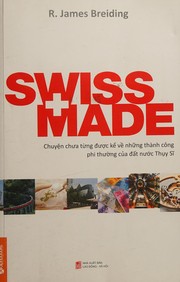
Swiss Made
The best single account of how Swiss firms built durable niches.
Summary
James Breiding, a Swiss-American financier, asks why a small landlocked country with no natural resources produces a disproportionate number of world-leading companies. The book covers the major Swiss industries through their firms and their histories.
The sectors treated include watches, from the industry's origins through the quartz crisis and the Swatch recovery; pharmaceuticals and the Basel chemical companies that became Novartis and Roche; food, principally Nestle; banking and insurance, including the private banks and the reinsurance industry; machinery and precision engineering; commodity trading, which Breiding treats as an under-recognised Swiss industry; and tourism. Each chapter is a business history with the specific competitive position identified.
Breiding's explanatory framework emphasises scarcity as a discipline, since the absence of a domestic market forced firms to export from the beginning; the apprenticeship and vocational training system; political decentralisation and the resulting competition between cantons; neutrality and the capital inflows it attracted; and immigration, particularly the Huguenot refugees who brought watchmaking and the German chemists who founded the Basel industry. The book is admiring and the causal claims are not tested against comparison cases. The individual company histories are well researched and are the reason to read it.
Key takeaways 7
- The absence of a domestic market forced Swiss firms to export from their founding, which imposed international competitive standards early.
- The apprenticeship and vocational training system supplies technical skill at a level other countries reserve for university graduates.
- Political decentralisation created competition between cantons for business, which constrained taxation and regulation.
- The Basel pharmaceutical industry originated with dye chemistry and with immigrant chemists excluded from patent protection elsewhere.
- The quartz crisis nearly destroyed Swiss watchmaking, and the recovery came from repositioning the product as luxury rather than as timekeeping.
- Neutrality attracted capital seeking safety, which built the banking industry independently of any Swiss commercial advantage.
- Breiding argues that resource scarcity acted as a discipline that resource-rich countries never faced.
Who should read it
Investors and operators interested in why small economies produce disproportionate numbers of global firms, through specific company histories.
Similar books 6
Chosen by shared topics, the entries that hold them, and the people who recommended both.

Harvard business historian; sets her brand-building against the whole industry.
Why big industrial firms in the US, Britain and Germany rose or lagged, 1880 to 1940.
How DuPont, GM, Standard Oil and Sears built the multidivisional firm.
A short history of the joint stock company, from trading charters to multinationals.
Recommended by: Paul Graham
How salaried managers replaced markets in coordinating US business, 1840 to 1920.
Recommended by: Paul Graham
McKinsey survey of operating companies; Ghana appears among the consumer-market cases.
Where it sits in the reference 3
Topics