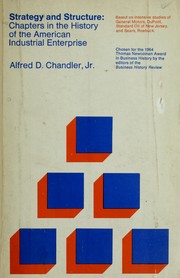
Strategy and Structure
Sears is one of Chandler's four case studies in the multidivisional firm.
Summary
Chandler studied the archives of DuPont, General Motors, Standard Oil of New Jersey and Sears Roebuck, and produced the founding work of business history as an academic discipline. Each company faced the same problem in the 1920s: a centralised functional organisation that worked while the firm made one product line for one market broke down once the firm diversified across products and geographies.
The finding is the book's famous thesis, that structure follows strategy. Firms first adopt a growth strategy, usually diversification driven by the need to use existing resources more fully, then encounter administrative overload, then invent a new structure to cope. In all four cases the answer was the multidivisional form, in which a general office handles capital allocation and long-range planning while autonomous divisions run their own operations with their own profit and loss. Chandler shows that the four firms arrived at the design independently and for the same reasons, which is what makes the argument structural rather than biographical.
The book matters to operators because it explains why organisational redesign lags strategy, sometimes by years, and why the lag is costly. It matters to investors because the divisional structure it documents is still the default for diversified corporations and the analysis of what the corporate centre should and should not do remains sharp. The thesis has been substantially qualified since: later scholars including Chandler himself allowed that structure also constrains strategy, and the multidivisional form itself has been criticised for encouraging conglomerate diversification that markets can do better. The evidence base is also four American manufacturers in one era.
Key takeaways 7
- Firms change organisational structure only after a growth strategy has already created administrative problems that the existing structure cannot handle.
- The multidivisional form was invented independently by four American companies facing the same overload, which shows it was a response to a structural problem rather than a management fashion.
- Diversification is driven primarily by the desire to use existing resources and capabilities more fully, not by portfolio logic.
- A corporate general office should handle capital allocation, executive appointment and long-range planning, and should not run operations.
- Divisional autonomy is only workable when each division has clear profit accountability and controls the resources that determine its results.
- Structural adaptation is delayed because the executives who built the existing structure are the ones who must dismantle it.
- Administrative coordination inside a firm can allocate resources more efficiently than market transactions when volume and throughput are high.
Who should read it
Executives redesigning an organisation after a period of growth or diversification, and investors assessing whether a corporate centre adds value.
About Alfred D. Chandler Jr.
Professor of business history at Harvard Business School; won a Pulitzer Prize for The Visible Hand and died in 2007.
Strategy and Structure established that firms adopt the multidivisional form once they diversify, and The Visible Hand showed how salaried managers displaced market coordination inside large American enterprises - the source texts for how conglomerates and holding companies are analysed. Scale and Scope extends the comparison to Britain and Germany and explains why different ownership patterns produced different corporate structures.
Similar books 6
Chosen by shared topics, the entries that hold them, and the people who recommended both.
Why big industrial firms in the US, Britain and Germany rose or lagged, 1880 to 1940.
How salaried managers replaced markets in coordinating US business, 1840 to 1920.
Recommended by: Paul Graham

A short history of the joint stock company, from trading charters to multinationals.
Recommended by: Paul Graham
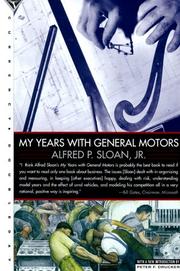
The decentralised structure and financial controls that ran General Motors.
Recommended by: Mohnish Pabrai, Patrick Collison and 1 other
The value chain: how to find where a firm's cost or differentiation advantage lies.

Harvard business historian; sets her brand-building against the whole industry.
Where it sits in the reference 7
Topics