Updates

  1. Person pages list letters, writing, profiles and links as sortable tables with filters, and show each person's companies as links; Fund letters show each letter's description in its own column.
  2. Experts show a checked job title and a short description of each person; 30 more people have photographs.
  3. Every company, fund, university and publication the experts work for has a page listing the people there.
  4. Fund letters show each letter's thesis and filter by it; 225 person pages list the essays, columns and newsletter issues the person wrote.
  5. Person pages list every essay and newsletter issue a person wrote, and their own books as a table in List view.
  6. Recommends shows the five largest kinds of book and the rest under More; browse pictures load sooner.
  7. Podcasts and talks link the original episode, filter by Audio and video or Press, and list each publisher once.
  8. Pages are wider, Recommends has List and Grid, and a filter clicked again turns off.
  9. Book cards sit in a ruled grid with Open Library and Goodreads links and each book's one-line note.
  10. Funds is now Investors; each investor's styles are buttons that filter the table.
  11. Podcasts and talks on a person's page filter by year and publisher and show as a list or a grid of pictures.
  12. Quotes show only people's own words: 472 summaries written by list sites are gone.
  13. Country pages open from Browse again, and every link on the shelf lands on a page.
  14. Subject and person pages show their sections as tabs, and each book appears once on a person's page.
  15. Book cards show the quote, who said it and the source; grids show five cards to a row.
  16. On a phone, a menu holds the sections, search, Updates, Feedback and dark mode.
  17. Feedback takes a screenshot of the page with no browser prompt, opens a screenshot full size when you click it, and clears itself once sent.
  18. Book cards are centred, search names the topic each book sits in, and any text cut short shows whole on hover.
  19. Search groups its results by kind: people, companies, geographies, subjects, topics, books, funds, fund letters and papers.
  20. The Books table lists who recommended each book by name, and the browser tab names the section you are in.
  21. Feedback can take a screenshot of the page, or one you paste or choose, and opens in the corner beside Updates.
  22. Each rail button reopens its section where you left it, and Browse, Table and People show on every book and subject page.
  23. Filters grey out choices that hold nothing instead of hiding them, and Books › People filters by authors or recommenders.
  24. Feedback takes a subject line and up to three screenshots.
  25. Biographies are grouped by the person they are about: 41 new pages, from Abraham Lincoln to Lee Kuan Yew.
  26. Sport splits into 23 sports, and Religion into one topic per faith.
  27. Book lists show as cards: the cover, one recommendation quote and every recommender by name.
  28. Seventeen subjects that had two or three pages under different names now have one page each.
  29. Every page lists its Experts as authors and recommenders, with a link to them on the Experts tab.
  30. Economics, Financial history, Financial panics and Accounting are subjects of their own, with one page per financial crisis.
  31. Book, person and subject pages open inside the app, so the tabs stay in view.
  32. 996 more book covers, and photographs or logos for 227 more people and companies.
  33. Books › Browse shows every subject as cards, and the rail holds Fund letters, Papers, Experts, Books and Funds.
  34. Every topic over 150 books splits into narrower topics, each with a page of its own.

Send feedback

What is it?
Screenshots, up to 3 (optional)
or paste one with Ctrl+V

We use your email only to reply to you.

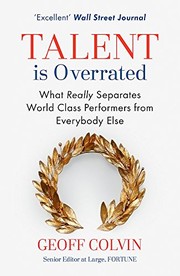
Talent Is Overrated: What Really Separates W

Talent Is Overrated: What Really Separates World-Class Performers from Everybody Else

Geoffrey Colvin
2008
T4 Open Librarygoodreads

Summary

Colvin, a Fortune editor, argues that specific innate talent does not explain elite performance and that deliberate practice does. He surveys the research, principally Anders Ericsson's, and applies it to business rather than to the music and sport contexts where it was developed. His attack on the talent explanation covers the absence of evidence for domain-specific innate ability, the finding that childhood indicators do not predict elite adult performance well, and the study of Mozart's early work showing that the compositions before roughly ten years of training were not exceptional.

His account of deliberate practice specifies what distinguishes it from ordinary repetition: it is designed specifically to improve performance, frequently by a teacher; it can be repeated a great deal; feedback on results is continuously available; it is highly demanding mentally and cannot be sustained for long periods; and it is not enjoyable. He is explicit that this last property explains why most people do not do it.

The business application is the book's contribution. Colvin argues that most professional work provides no feedback loop, that experience therefore does not produce improvement, and that a professional wanting to improve must construct the practice conditions themselves, including defining specific aspects to work on, seeking feedback that would not otherwise arrive, and practising components separately from actual performance.

The research base has weakened since publication, with meta-analyses finding that deliberate practice accounts for a smaller share of performance variance than Ericsson claimed, particularly outside highly structured domains. The construction of practice conditions in unstructured professional work remains the useful part.

Key takeaways 8

  1. Innate domain-specific talent does not explain elite performance, and childhood indicators predict adult outcomes poorly.
  2. Deliberate practice is designed specifically to improve performance, is repeatable, provides continuous feedback and is mentally demanding.
  3. Deliberate practice is not enjoyable, which is the property that explains why most people do not do it.
  4. Experience alone does not produce improvement, and professionals with decades of practice frequently perform no better than those with a few years.
  5. Most professional work provides no feedback loop, which means the conditions for improvement must be constructed deliberately.
  6. Components of a skill should be practised separately from actual performance, which most professionals never do.
  7. Working at a level that produces frequent errors is required, and comfortable performance indicates that no improvement is occurring.
  8. Meta-analyses since publication find that deliberate practice explains a smaller share of performance variance than the book claims.

Who should read it

Professionals in unstructured fields who want to construct practice conditions their work does not supply, with the effect sizes treated as overstated.

Who recommended it 3 · 1 direct

Alfred Linreported
Donald Trumpreported

Similar books 6

Chosen by shared topics, the entries that hold them, and the people who recommended both.

Adam Grant · 2013

Givers, takers and matchers, and why givers end up both at the bottom and the top.

Where it sits in the reference 3

Business themes
Business themes
Business themes

Topics

Psychology and BehaviourBusiness and ManagementLearning, expertise and creativity