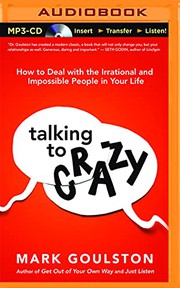
Talking to Crazy
How to deal with irrational, volatile and manipulative people at work and at home.
Summary
Mark Goulston, a psychiatrist and author of Just Listen, explains how to deal with irrational people: the boss with nonsensical demands, the spouse who explodes at nothing, the overly emotional colleague, the hostile neighbour or the friend who often bursts into tears. Such people, he writes, drag down marriages, families, friendships, careers and businesses with manipulation, volatility and an inability to see the world rationally, and neither ignoring them nor arguing works.
Goulston's key is to "lean into the crazy": to empathise with it, which changes the dynamic and turns the listener from a threat into an ally. He explains this counterintuitive "Sanity Cycle": why people act as they do, how instinctive responses make things worse and what to do instead, and when to confront a problem and when to walk away. He gives a range of techniques with names such as Time Travel, the Fish-bowl and the Belly Roll. His conclusion is that unreasonable people cannot be reasoned with, but they can be reached.
Key takeaways 4
- Arguing with an irrational person makes the situation worse.
- Empathising with irrational behaviour turns a perceived threat into an ally.
- Instinctive reactions often escalate conflict.
- Sometimes the right move is to walk away.
Who should read it
Anyone who has to deal with volatile or irrational people at work or at home.
Who recommended it 1
Similar books 6
Chosen by shared topics, the entries that hold them, and the people who recommended both.
How persuasion and propaganda work through advertising, television and opinion.
Recommended by: Ramit Sethi, Tim Ferriss
A step-by-step approach to business negotiation from Wharton's negotiation workshop.
Leadership as the ability to change minds, and what moves them.
Recommended by: Ray Dalio
How eye contact can build relationships and confidence and win negotiations.
Recommended by: Sheryl Sandberg
Techniques for handling people, being liked and winning others to your view.
“If you want to learn what people want, read Dale Carnegie's How to Win Friends and Influence People.” — Paul Graham
Source: Why Smart People Have Bad Ideas
Recommended by: Mohnish Pabrai, Patrick Collison and 14 others
How biases such as anchoring and the winner's curse distort bargaining.