Updates

  1. Person pages list letters, writing, profiles and links as sortable tables with filters, and show each person's companies as links; Fund letters show each letter's description in its own column.
  2. Experts show a checked job title and a short description of each person; 30 more people have photographs.
  3. Every company, fund, university and publication the experts work for has a page listing the people there.
  4. Fund letters show each letter's thesis and filter by it; 225 person pages list the essays, columns and newsletter issues the person wrote.
  5. Person pages list every essay and newsletter issue a person wrote, and their own books as a table in List view.
  6. Recommends shows the five largest kinds of book and the rest under More; browse pictures load sooner.
  7. Podcasts and talks link the original episode, filter by Audio and video or Press, and list each publisher once.
  8. Pages are wider, Recommends has List and Grid, and a filter clicked again turns off.
  9. Book cards sit in a ruled grid with Open Library and Goodreads links and each book's one-line note.
  10. Funds is now Investors; each investor's styles are buttons that filter the table.
  11. Podcasts and talks on a person's page filter by year and publisher and show as a list or a grid of pictures.
  12. Quotes show only people's own words: 472 summaries written by list sites are gone.
  13. Country pages open from Browse again, and every link on the shelf lands on a page.
  14. Subject and person pages show their sections as tabs, and each book appears once on a person's page.
  15. Book cards show the quote, who said it and the source; grids show five cards to a row.
  16. On a phone, a menu holds the sections, search, Updates, Feedback and dark mode.
  17. Feedback takes a screenshot of the page with no browser prompt, opens a screenshot full size when you click it, and clears itself once sent.
  18. Book cards are centred, search names the topic each book sits in, and any text cut short shows whole on hover.
  19. Search groups its results by kind: people, companies, geographies, subjects, topics, books, funds, fund letters and papers.
  20. The Books table lists who recommended each book by name, and the browser tab names the section you are in.
  21. Feedback can take a screenshot of the page, or one you paste or choose, and opens in the corner beside Updates.
  22. Each rail button reopens its section where you left it, and Browse, Table and People show on every book and subject page.
  23. Filters grey out choices that hold nothing instead of hiding them, and Books › People filters by authors or recommenders.
  24. Feedback takes a subject line and up to three screenshots.
  25. Biographies are grouped by the person they are about: 41 new pages, from Abraham Lincoln to Lee Kuan Yew.
  26. Sport splits into 23 sports, and Religion into one topic per faith.
  27. Book lists show as cards: the cover, one recommendation quote and every recommender by name.
  28. Seventeen subjects that had two or three pages under different names now have one page each.
  29. Every page lists its Experts as authors and recommenders, with a link to them on the Experts tab.
  30. Economics, Financial history, Financial panics and Accounting are subjects of their own, with one page per financial crisis.
  31. Book, person and subject pages open inside the app, so the tabs stay in view.
  32. 996 more book covers, and photographs or logos for 227 more people and companies.
  33. Books › Browse shows every subject as cards, and the rail holds Fund letters, Papers, Experts, Books and Funds.
  34. Every topic over 150 books splits into narrower topics, each with a page of its own.

Send feedback

What is it?
Screenshots, up to 3 (optional)
or paste one with Ctrl+V

We use your email only to reply to you.

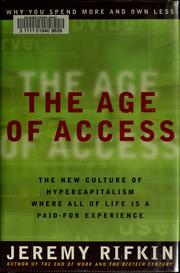
The Age of Access

The Age of Access

Jeremy Rifkin
2000
T3 316 pages · about 5h 16m to read Open Librarygoodreads

Early and prescient case that access would displace ownership.

Summary

Jeremy Rifkin argued in 2000 that capitalism was shifting from the exchange of property to the granting of access, and that this change would transform both commerce and social life. Written at the peak of the first internet boom, the book anticipates several developments accurately and several not at all.

His central claim is that ownership is becoming less important than access to networks, and that markets are giving way to networks as the organising structure of commerce. Firms outsource physical assets and retain relationships; consumers subscribe rather than buy; suppliers become partners in continuous relationships rather than counterparties in discrete transactions. He predicted the growth of leasing and subscription across categories, the importance of the customer relationship over the product, and the shift of value toward intangibles and brands.

The second half concerns culture. Rifkin argues that commercial networks are absorbing the cultural sphere, so that experiences previously produced through community and shared life become purchased services, and that this depletes the social capital on which commerce itself depends. He treats this as the more important development and it is where his argument is weakest, since it depends on assertions about cultural depletion that he does not evidence. The subscription and access predictions were substantially correct and arrived earlier and more completely than most contemporaneous forecasts. Rifkin writes at length and repeats himself.

Key takeaways 7

  1. Access to a continuing service is displacing ownership of a discrete product across an expanding range of categories.
  2. Firms increasingly retain customer relationships and intangibles while outsourcing physical assets.
  3. Subscription relationships convert one-time transactions into continuing revenue and shift the basis of competition to retention.
  4. Rifkin argues that value has moved from the production of goods to the management of relationships and experiences.
  5. Networks rather than markets become the organising structure when transactions are continuous rather than discrete.
  6. Commercial provision of experiences previously produced through community depletes the social capital that commerce relies on.
  7. The cultural argument rests on assertions about social depletion that the book does not evidence.

Who should read it

Operators building subscription and access businesses who want an early and largely accurate account of the shift, with its cultural chapters read sceptically.

Similar books 6

Chosen by shared topics, the entries that hold them, and the people who recommended both.
Arun Sundararajan · 2016

Economics of trust and matching that make marketplaces like Airbnb work.
Joe Weinman · 2012

The maths of pay-per-use versus owned capacity.

Aaron Perzanowski, Jason Schultz · 2016

How licensing in place of sale strips buyers of control over what they paid for.

Rebecca Giblin, Cory Doctorow · 2022

How intermediaries capture creative-work rents; the bear case for creators.

Stephen Witt · 2015

How the mp3, a CD-factory leaker and pirate websites broke the music business.

Where it sits in the reference 2

Business models
Business models

Topics

Sociology and CultureTechnology and ComputingMedia and technology in societyTech strategy and platform economics