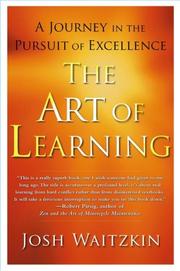
The Art of Learning
What a chess prodigy turned tai chi champion learned about learning itself.
Summary
Waitzkin was a chess prodigy, the subject of the film Searching for Bobby Fischer, and later won world championships in tai chi push hands. The book examines what transferred between two apparently unrelated disciplines and argues that the transferable element is the process of learning rather than any content.
His central technical concepts include making smaller circles, meaning taking a single technique and refining it inward until it becomes internalised and can be executed with minimal movement; investment in loss, meaning deliberately accepting defeat during training in order to learn, which requires giving up short-term results; and numbers to leave numbers, meaning that explicit rules are learned thoroughly and then discarded as the understanding becomes intuitive.
He also covers the entity and incremental theories of intelligence, which map onto Dweck's fixed and growth mindsets and which Waitzkin encountered as a child prodigy praised for talent; the soft zone, meaning the ability to remain focused amid disruption rather than requiring ideal conditions; building trigger routines that reliably produce a performance state; and the management of physical and emotional state as a component of intellectual performance.
The chapters on his own failures, including the period after the film when he could not play chess without the weight of his public identity, are the most honest. The evidence is entirely personal. Waitzkin generalises from two disciplines and from his own unusual capability, which limits how much a reader can conclude. The specific techniques, particularly investment in loss and making smaller circles, are stated concretely enough to apply to any skill acquired over years.
Key takeaways 8
- The transferable element between disciplines is the process of learning rather than any technique or content.
- Deliberately accepting losses during training, in exchange for learning, is required to progress past the level your current approach supports.
- A single technique refined inward until it requires minimal movement produces more capability than accumulating many techniques.
- Explicit rules should be learned thoroughly and then discarded, since the objective is intuition that no longer references them.
- Believing that ability is fixed produces avoidance of the challenges that would develop it, which Waitzkin experienced directly as a praised prodigy.
- Performance requires remaining focused amid disruption rather than securing ideal conditions, which can be trained deliberately.
- A repeatable routine can be built that reliably produces a performance state, and it can then be compressed into a shorter version for use under pressure.
- Physical and emotional state determine intellectual performance, which means recovery and conditioning are part of the practice rather than adjacent to it.
Who should read it
People developing a skill over years who want concrete techniques for deliberate practice from someone who reached the top in two unrelated fields.
Who recommended it 9 · 5 direct
“Chess master becomes Tai Chi master, realizes his real genius is learning, and shares his insights and stories.”
Similar books 6
Chosen by shared topics, the entries that hold them, and the people who recommended both.
A journalist learns memory techniques and wins the US Memory Championship.
“For those fascinated with memory. Riveting page-turner about a journalist (with no particularly good memory) who went to cover a memory championship event. Intrigued and befriending some competitors, he starts practicing, and a year later wins the U.S. memory championship event himself. Inspiring dive into the subject of memorization.” — Derek Sivers
Source: Derek Sivers book notes (primary, rated list) · Rating: 8/10
Recommended by: Bill Gates, Derek Sivers, Mohnish Pabrai and 5 others
How masters from Leonardo to Faraday found a life's task and served apprenticeships.
“Mostly detailed historical biographical tales of ”masters” like DaVinci, Darwin, Mozart, Proust, Goethe, Wright Brothers, Einstein, Coltrane, Martha Graham, etc. Lessons dissected from their successes, and categorized. Similar format to his great book “48 Laws of Power”, but a little less effective here. The biographies were interesting, but lessons were mostly conventional wisdom.” — Derek Sivers
Source: Derek Sivers book notes (primary, rated list) · Rating: 5/10
Recommended by: Derek Sivers, Nat Eliason, Ryan Holiday and 6 others
Early specialisation works only where rules are stable; elsewhere breadth wins.
“In the book Range: Why Generalists Triumph in a Specialist World2, author David Epstein argues that many fields have gone so overboard with specialization that generalists are now the more valuable problem solvers.” — Bill Nygren
Source: Bill Nygren Market Commentary | 2Q19
Recommended by: Bill Gates, Bill Nygren, Michael Mauboussin and 12 others
Field-tested tips for improving skills in sport, music, art, maths and business.
“First he wrote The Talent Code, which I also highly recommend, then he distilled all that research about deliberate practice into 52 actionable tips. Amazing and inspiring, you can read the whole thing in 90 minutes, then get to work!” — Derek Sivers
Source: Derek Sivers book notes (primary, rated list) · Rating: 8/10
Recommended by: Derek Sivers, Nat Eliason, David Cancel
How talent is grown, not born, through a brain mechanism training can tap.
“A great book showing that deep practice - (struggling in certain targeted ways - operating at the edges of your ability, where you make mistakes - experiences where you're forced to slow down, make errors, and correct them) - is what really makes you improve at anything.” — Derek Sivers
Source: Derek Sivers book notes (primary, rated list) · Rating: 8/10
Recommended by: Derek Sivers, Michael Mauboussin and 5 others
What research shows about how people learn, against common study habits.
Recommended by: Nat Eliason