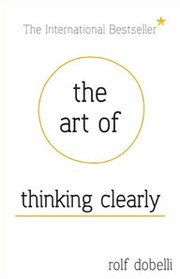
The Art of Thinking Clearly
Ninety-nine cognitive errors in short chapters, each with how to avoid it.
A working catalogue of 99 cognitive errors, organized so you can actually use it. Less academic than Kahneman, more encyclopedic than Duke. The format — one bias per short chapter — makes it useful as a pre-mortem checklist before consequential decisions.
Summary
Dobelli presents ninety-nine cognitive errors in short chapters of two or three pages each, each naming a bias, illustrating it and giving a brief instruction on avoiding it.
The coverage includes survivorship bias, swimmer's body illusion which confuses selection with effect, the clustering illusion, social proof, sunk cost, reciprocity, confirmation bias, authority bias, contrast effect, availability, the story bias, hindsight, overconfidence, the chauffeur knowledge distinction between people who know a subject and people who can perform knowing it, base rate neglect, regression to the mean, outcome bias, the paradox of choice, endowment, groupthink, neglect of probability, scarcity error, and many others. The format is designed for reference rather than for sequential reading, and Dobelli says so.
The book is entirely derivative. Nearly every chapter restates work by Kahneman, Tversky, Taleb, Cialdini or Gigerenzer, and Dobelli was publicly criticised by Taleb and by Gigerenzer for the extent of the borrowing without adequate attribution in the original German edition. Several of the underlying findings have replicated poorly, and the compressed format leaves no room to indicate which. The instructions on avoiding each bias are brief to the point of uselessness, since knowing about a bias does not prevent it.
Its value is as an index. A reader who wants a name for a pattern they have observed will find it here quickly, and can then go to the primary sources. Anyone who has read Kahneman and Cialdini will find nothing new.
Key takeaways 8
- Ninety-nine recognised cognitive errors can be named and described compactly, which gives a reader a vocabulary for patterns they observe.
- Survivorship bias makes any study of successful cases systematically misleading, because the failures left no record.
- Confusing selection with effect, which Dobelli calls the swimmer's body illusion, invalidates most inferences about what a practice produced.
- Knowing about a bias does not prevent committing it, which the book's brief avoidance instructions do not address.
- Chauffeur knowledge, meaning the ability to perform knowing something without actually knowing it, is widespread among public commentators.
- The book restates work by Kahneman, Tversky, Taleb, Cialdini and Gigerenzer, and the borrowing drew public criticism from two of them.
- Several underlying findings have replicated poorly and the compressed format gives no indication of which.
- The format works as an index for finding the name of a pattern rather than as a source for understanding it.
Who should read it
Readers who want a quick index of named cognitive errors, with the primary sources used for anything they intend to rely on.
Who recommended it 1 · 1 direct
Similar books 6
Chosen by shared topics, the entries that hold them, and the people who recommended both.
How fast, automatic thought and slow, deliberate thought shape judgment and error.
“…books I've recommended, highlighted to death, or forced on friends.” — Andrew Wilkinson
Source: Andrew Wilkinson's Bookshelf, neverenough.com
Recommended by: Andrew Wilkinson, Charles de Vaulx and 36 others
Why people misjudge, with thinking tools from Munger, Buffett, Darwin and Feynman.
“…books I've recommended, highlighted to death, or forced on friends.” — Andrew Wilkinson
Source: Andrew Wilkinson's Bookshelf, neverenough.com
Recommended by: Andrew Wilkinson, David Perell, Derek Sivers and 9 others
How cognitive dissonance drives people to justify their mistakes, not admit them.
“We are wired for self-justification. We create fictions that absolve us of responsibility, restoring our belief that we are smart, moral, and right — a belief that often keeps us on a course that is dumb, immoral, and wrong.” — Derek Sivers
Source: Derek Sivers book notes (primary, rated list) · Rating: 3/10
Recommended by: Derek Sivers, Howard Marks, Mohnish Pabrai and 3 others

Why people mistake luck for skill, above all in markets.
“Fooled By Randomness was unquestionably the best non-fiction book I read in 2005.” — Brad Feld
Source: Book Review: Fooled By Randomness — Feld Thoughts
Recommended by: Barton Biggs, Brad Feld, Derek Sivers and 15 others
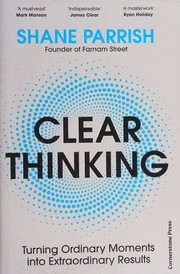
How four default reactions decide most choices before any conscious decision.

Rare, unforeseen, high-impact events drive history, explained only after the fact.
“The Black Swan U The best-known bird around today is The Black Swan, the second book from Nassim Nicolas Taleb.” — Howard Marks
Source: The Complete Collection, page 530
Recommended by: David Perell, Howard Marks, Marc Andreessen and 20 others