Updates

  1. Person pages list letters, writing, profiles and links as sortable tables with filters, and show each person's companies as links; Fund letters show each letter's description in its own column.
  2. Experts show a checked job title and a short description of each person; 30 more people have photographs.
  3. Every company, fund, university and publication the experts work for has a page listing the people there.
  4. Fund letters show each letter's thesis and filter by it; 225 person pages list the essays, columns and newsletter issues the person wrote.
  5. Person pages list every essay and newsletter issue a person wrote, and their own books as a table in List view.
  6. Recommends shows the five largest kinds of book and the rest under More; browse pictures load sooner.
  7. Podcasts and talks link the original episode, filter by Audio and video or Press, and list each publisher once.
  8. Pages are wider, Recommends has List and Grid, and a filter clicked again turns off.
  9. Book cards sit in a ruled grid with Open Library and Goodreads links and each book's one-line note.
  10. Funds is now Investors; each investor's styles are buttons that filter the table.
  11. Podcasts and talks on a person's page filter by year and publisher and show as a list or a grid of pictures.
  12. Quotes show only people's own words: 472 summaries written by list sites are gone.
  13. Country pages open from Browse again, and every link on the shelf lands on a page.
  14. Subject and person pages show their sections as tabs, and each book appears once on a person's page.
  15. Book cards show the quote, who said it and the source; grids show five cards to a row.
  16. On a phone, a menu holds the sections, search, Updates, Feedback and dark mode.
  17. Feedback takes a screenshot of the page with no browser prompt, opens a screenshot full size when you click it, and clears itself once sent.
  18. Book cards are centred, search names the topic each book sits in, and any text cut short shows whole on hover.
  19. Search groups its results by kind: people, companies, geographies, subjects, topics, books, funds, fund letters and papers.
  20. The Books table lists who recommended each book by name, and the browser tab names the section you are in.
  21. Feedback can take a screenshot of the page, or one you paste or choose, and opens in the corner beside Updates.
  22. Each rail button reopens its section where you left it, and Browse, Table and People show on every book and subject page.
  23. Filters grey out choices that hold nothing instead of hiding them, and Books › People filters by authors or recommenders.
  24. Feedback takes a subject line and up to three screenshots.
  25. Biographies are grouped by the person they are about: 41 new pages, from Abraham Lincoln to Lee Kuan Yew.
  26. Sport splits into 23 sports, and Religion into one topic per faith.
  27. Book lists show as cards: the cover, one recommendation quote and every recommender by name.
  28. Seventeen subjects that had two or three pages under different names now have one page each.
  29. Every page lists its Experts as authors and recommenders, with a link to them on the Experts tab.
  30. Economics, Financial history, Financial panics and Accounting are subjects of their own, with one page per financial crisis.
  31. Book, person and subject pages open inside the app, so the tabs stay in view.
  32. 996 more book covers, and photographs or logos for 227 more people and companies.
  33. Books › Browse shows every subject as cards, and the rail holds Fund letters, Papers, Experts, Books and Funds.
  34. Every topic over 150 books splits into narrower topics, each with a page of its own.

Send feedback

What is it?
Screenshots, up to 3 (optional)
or paste one with Ctrl+V

We use your email only to reply to you.

The Cold Start Problem

The Cold Start Problem

Andrew Chen
2021
T2 304 pages · about 5h 4m to read Open Librarygoodreads

Free tiers used as the tool for reaching network critical mass.

Summary

Chen, a partner at Andreessen Horowitz who previously worked at Uber, addresses the specific problem of launching a network product that has no value until other people are using it.

His framework has five stages. The cold start problem itself, where the product is worthless until a minimum viable network exists, and the solution is to build the smallest network that provides value to its members, which he calls an atomic network, and to build many of these rather than trying to grow one large one. The tipping point, where the product acquires networks faster than it loses them, achieved through mechanisms including invitations, paid acquisition against known lifetime value, and what he calls the come for the tool stay for the network approach. Escape velocity, where growth becomes self-sustaining through the acquisition, engagement and economic effects operating together. The ceiling, where growth stalls because of market saturation, spam, degraded quality or overcrowding of the network. And the moat, where network effects become defensive against competitors.

The specific content on atomic networks is the most useful part. Chen's argument that Uber launched city by city and even neighbourhood by neighbourhood, and that a network product's minimum viable unit is far smaller than founders assume, is directly applicable.

The book draws on Chen's own experience and on interviews with operators at network companies. It is practitioner synthesis rather than research, the failure cases receive less attention than the successes, and the venture capital vantage point shapes which examples appear.

Key takeaways 7

  1. A network product must first build the smallest network that provides value to its own members rather than attempting to grow one large network.
  2. The minimum viable network is far smaller than founders assume, which is why launching city by city or campus by campus works.
  3. Building many small networks separately and then connecting them is more reliable than growing a single network from the centre.
  4. Offering a useful single-player tool first, with the network arriving later, solves the cold start problem for products that permit it.
  5. Growth stalls at a ceiling caused by saturation, spam, quality degradation or network overcrowding, and each requires a different response.
  6. Network effects become defensive only after the network is dense enough that a competitor cannot assemble an equivalent one.
  7. The economic effect of a network, meaning improving unit economics as it grows, is distinct from the acquisition and engagement effects and arrives last.

Who should read it

Founders and investors building or evaluating network products who need a staged framework for the launch and growth problems specific to them.

Who recommended it 1

Reid Hoffmanreported

Similar books 6

Chosen by shared topics, the entries that hold them, and the people who recommended both.
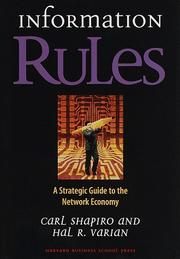
Carl Shapiro, Hal R. Varian · 1998

Economics for information goods: pricing, versioning, lock-in and network effects.

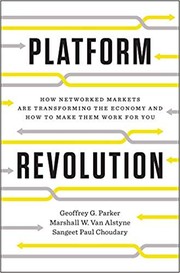
Geoffrey G. Parker, Marshall W. Van Alstyne, Sangeet Paul Choudary · 2016

How platforms create value by matching groups, unlike linear pipeline businesses.

Recommended by: Reid Hoffman

T2 Free
Chris Anderson · 2009

Digital costs near zero mean goods can be given away, which changes whole industries.

Eric Benjamin Seufert · 2013

The arithmetic of conversion rates, whales and lifetime value.
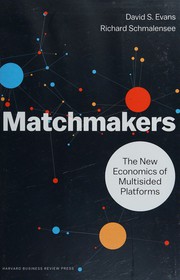
David S. Evans, Richard Schmalensee · 2016

How multi-sided platforms such as card networks get both sides on board at once.
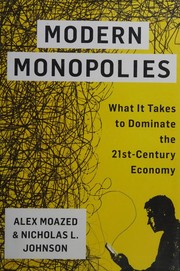
Alex Moazed, Nicholas L. Johnson · 2016

Practitioner account of how platform businesses capture a transaction.

Where it sits in the reference 2

Business models
Business models

Topics

Entrepreneurship and StartupsTechnology and ComputingGrowth, Sales and MarketingTech strategy and platform economics