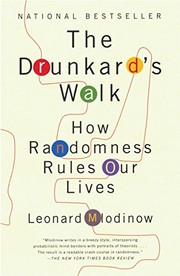
The Drunkard's Walk
How randomness shapes our lives, the history of probability, and why we misread it.
Summary
Mlodinow, a physicist, wrote an accessible book on randomness and probability, combining the history of the mathematics with evidence that people reason about it badly.
The historical thread runs from Cardano's early work on gambling odds through Pascal and Fermat's correspondence, Bernoulli's law of large numbers, Bayes and the problem of inverse probability, Laplace, Gauss and the normal distribution, and the development of statistics. Mlodinow explains each concept through the problem its originator was trying to solve.
The psychological thread reports the standard findings on probabilistic reasoning: the conjunction fallacy, where a specific conjunction is judged more probable than one of its components; base rate neglect, illustrated with medical testing where a positive result on an accurate test for a rare condition usually indicates no condition; the availability heuristic; the misunderstanding of conditional probability shown by the Monty Hall problem and by the prosecutor's fallacy; and the tendency to find patterns in random sequences, including the clustering illusion and the hot hand.
The applied argument concerns how much of observed success is randomness. Mlodinow examines mutual fund manager records, corporate executive performance, film studio executives, wine ratings, publishing decisions and sports streaks, arguing in each case that the observed distribution of outcomes is consistent with chance operating on small underlying differences, and that our tendency to construct causal narratives after the fact makes randomness invisible.
The book covers ground also covered by Taleb and Kahneman. Some of the psychology studies cited come from literatures affected by replication problems since 2008, though the core probability findings have held. The treatment is introductory and a reader with statistical training will find little new.
Key takeaways 7
- A positive result on an accurate test for a rare condition usually indicates the absence of the condition, because the base rate dominates.
- People judge specific detailed scenarios as more probable than the general cases that contain them, which is logically impossible.
- Random sequences produce clusters and streaks that observers reliably interpret as patterns.
- Mutual fund manager records over typical measurement periods are consistent with chance operating on small differences in skill.
- Success in fields with high outcome variance is attributed to individual quality afterward, regardless of what produced it.
- Conditional probability is reversed routinely in legal and medical reasoning, which produces systematic errors with serious consequences.
- Constructing a causal narrative after an outcome makes the role of randomness invisible even to people who understand probability.
Who should read it
Readers who want an accessible introduction to probability and to the errors people make with it, particularly when assessing track records.
Who recommended it 3 · 3 direct
“I thought it was about the philosophy of randomness, but turned out to be about the math of probability. Might read again some day when in the mood for that.”
“Leonard Mlodinow, The Drunkard’s Walk: How Randomness Rules Our Lives (New York: Pantheon Books, 2008), 180-181”
Similar books 6
Chosen by shared topics, the entries that hold them, and the people who recommended both.
How people learned to measure risk, from early probability to portfolio theory.
“(Risk is the subject of Peter Bernstein’s wonderful new book, Against the Gods: The Remarkable Story of Risk.)” — Bill Miller
Source: 1996 Q3 Market Commentary
Recommended by: Bill Miller, Charles de Vaulx, Howard Marks and 9 others
Whether clinical judgement or statistical formulas predict better in psychology.
“Paul E. Meehl, Clinical versus Statistical Prediction: A Theoretical Analysis and a Review of the Evidence (Minneapolis, MN: University of Minnesota Press, 1954)” — Michael Mauboussin
Source: BIN There, Done That: How to Reduce the Sources of Forecasting Error, page 14
Recommended by: Michael Mauboussin, Daniel Kahneman
Why anything a manager cares about can be measured, and how to measure it.
“Hubbard, Douglas, How to Measure Anything: Finding the Value of Intangibles in Business (Hoboken, NJ: John Wiley & Sons, 2007)” — Michael Mauboussin
Source: The Wisdom of Crowds in Markets: Crowd Behavior in Prediction, Betting, and Stock Markets
Recommended by: Michael Mauboussin, Julia Galef, Nick Ganju
About thirty formal models: what each explains and where each fails.
“Scott E. Page, The Model Thinker: What You Need to Know to Make Data Work for You (New York: Basic Books, 2018), 27-42” — Michael Mauboussin
Source: BIN There, Done That: How to Reduce the Sources of Forecasting Error, page 14
Recommended by: Michael Mauboussin, Keith Rabois
Why some forecasts succeed and most fail, from weather to earthquakes and economics.
“See Gigerenzer, Calculated Risks, 28-29. 14 For a book that treats this topic and more, see Annie Duke, Thinking in Bets: Making Smarter Decisions When You Don't Have All the Facts (New York: Portfolio/Penguin, 2018). 15 For a good discussion of Bayes’ Theorem, see Nate Silver, The Signal and the Noise: Why So Many Predictions Fail—But Some Don’t (New York, The Penguin Press, 2012), 232-261.” — Michael Mauboussin
Source: Confidence: Methods to Assess Confidence Under Uncertainty, page 7
Recommended by: Bill Gates, Michael Mauboussin and 2 others
How to separate skill from luck in business, sport and investing.
Recommended by: Keith Rabois, Mohnish Pabrai and 3 others
Where it sits in the reference 3
Topics 3
As an Amazon Associate I earn from qualifying purchases.