Updates

  1. Person pages list letters, writing, profiles and links as sortable tables with filters, and show each person's companies as links; Fund letters show each letter's description in its own column.
  2. Experts show a checked job title and a short description of each person; 30 more people have photographs.
  3. Every company, fund, university and publication the experts work for has a page listing the people there.
  4. Fund letters show each letter's thesis and filter by it; 225 person pages list the essays, columns and newsletter issues the person wrote.
  5. Person pages list every essay and newsletter issue a person wrote, and their own books as a table in List view.
  6. Recommends shows the five largest kinds of book and the rest under More; browse pictures load sooner.
  7. Podcasts and talks link the original episode, filter by Audio and video or Press, and list each publisher once.
  8. Pages are wider, Recommends has List and Grid, and a filter clicked again turns off.
  9. Book cards sit in a ruled grid with Open Library and Goodreads links and each book's one-line note.
  10. Funds is now Investors; each investor's styles are buttons that filter the table.
  11. Podcasts and talks on a person's page filter by year and publisher and show as a list or a grid of pictures.
  12. Quotes show only people's own words: 472 summaries written by list sites are gone.
  13. Country pages open from Browse again, and every link on the shelf lands on a page.
  14. Subject and person pages show their sections as tabs, and each book appears once on a person's page.
  15. Book cards show the quote, who said it and the source; grids show five cards to a row.
  16. On a phone, a menu holds the sections, search, Updates, Feedback and dark mode.
  17. Feedback takes a screenshot of the page with no browser prompt, opens a screenshot full size when you click it, and clears itself once sent.
  18. Book cards are centred, search names the topic each book sits in, and any text cut short shows whole on hover.
  19. Search groups its results by kind: people, companies, geographies, subjects, topics, books, funds, fund letters and papers.
  20. The Books table lists who recommended each book by name, and the browser tab names the section you are in.
  21. Feedback can take a screenshot of the page, or one you paste or choose, and opens in the corner beside Updates.
  22. Each rail button reopens its section where you left it, and Browse, Table and People show on every book and subject page.
  23. Filters grey out choices that hold nothing instead of hiding them, and Books › People filters by authors or recommenders.
  24. Feedback takes a subject line and up to three screenshots.
  25. Biographies are grouped by the person they are about: 41 new pages, from Abraham Lincoln to Lee Kuan Yew.
  26. Sport splits into 23 sports, and Religion into one topic per faith.
  27. Book lists show as cards: the cover, one recommendation quote and every recommender by name.
  28. Seventeen subjects that had two or three pages under different names now have one page each.
  29. Every page lists its Experts as authors and recommenders, with a link to them on the Experts tab.
  30. Economics, Financial history, Financial panics and Accounting are subjects of their own, with one page per financial crisis.
  31. Book, person and subject pages open inside the app, so the tabs stay in view.
  32. 996 more book covers, and photographs or logos for 227 more people and companies.
  33. Books › Browse shows every subject as cards, and the rail holds Fund letters, Papers, Experts, Books and Funds.
  34. Every topic over 150 books splits into narrower topics, each with a page of its own.

Send feedback

What is it?
Screenshots, up to 3 (optional)
or paste one with Ctrl+V

We use your email only to reply to you.

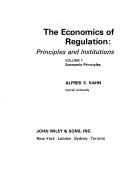
The Economics of Regulation

The Economics of Regulation

Alfred E. Kahn
1970
T1 480 pages · about 8h to read Open Librarygoodreads

The standard theory of rate base, allowed return and marginal-cost pricing.

Summary

Kahn wrote this two-volume work as the standard economic treatment of regulated industries, and he later applied its conclusions himself as chairman of the Civil Aeronautics Board, where he dismantled airline regulation.

The first volume covers principles. Kahn works through the economic case for regulating natural monopolies, meaning industries where a single firm can serve the market at lower cost than several, and then examines the pricing rules that follow. He develops the case for marginal cost pricing as the efficiency benchmark, then works through why regulated firms cannot generally price at marginal cost when average cost exceeds it, and examines the alternatives including two-part tariffs, peak-load pricing, and Ramsey pricing where markups vary inversely with demand elasticity. He treats the problem of common costs allocated across services, which he argues is analytically insoluble and therefore decided politically.

The second volume covers institutional practice and its failures. Rate of return regulation on the rate base creates the incentive, identified by Averch and Johnson, to over-invest in capital because the allowed return applies to the asset base. Regulatory lag alters incentives in ways the rules do not intend. Regulators extend their control beyond natural monopoly segments into competitive ones, which protects incumbents without any efficiency justification. Cross-subsidy between customer classes becomes entrenched and creates constituencies that resist reform.

Kahn's practical conclusion, which he acted on, is that regulation should apply only where market structure genuinely requires it, and that industries without natural monopoly characteristics, including airlines and trucking, should not be regulated at all.

The work is technical and written for economists. It is dated in its industry examples, and the subsequent experience of deregulation, including airline concentration and the electricity market failures, complicates the confidence of its conclusions.

Key takeaways 7

  1. Regulation is economically justified only where a single firm can serve the market at lower cost than several can.
  2. Marginal cost pricing is the efficiency benchmark, and every departure from it must be justified by the need to cover total cost.
  3. Peak-load pricing is required wherever capacity costs are driven by demand at particular times, and flat rates misallocate capacity.
  4. Rate of return regulation applied to the asset base gives firms an incentive to over-invest in capital.
  5. Allocating common costs across services has no economically correct answer, so the allocation is decided politically.
  6. Regulators extend control from genuinely monopolistic segments into competitive ones, which protects incumbents without efficiency justification.
  7. Cross-subsidies between customer classes create constituencies that make reform politically difficult regardless of the economics.

Who should read it

Economists, regulators and operators in regulated industries who need the analytical framework for pricing and for judging when regulation is justified.

Similar books 6

Chosen by shared topics, the entries that hold them, and the people who recommended both.

Thomas K. McCraw · 1984

A century of US regulation through four figures, from Charles Francis Adams to Kahn.

James C. Bonbright · 1961

The economic criteria for setting regulated utility rates.

Richard A. Posner · 1976

Antitrust should rest on the economics of efficiency, not on protecting competitors.

Matt Stoller · 2019

A political history of American monopoly and of the tradition that fought it.

Recommended by: David Heinemeier Hansson

David Dayen · 2020

Concentration traced sector by sector through its effects on customers.

William Lazonick, Jang-Sup Shin · 2020

The academic case that repurchases hollow out corporate investment.

Where it sits in the reference 3

Business models
Business themes
Economics

Topics

EconomicsPolitics and GovernmentRegulation, central banks and public policy